.
When the trailer for this came out, I couldn’t help but see it as a bit of a spiritual sequel to Wicked, and the fact that the title is only a single letter different does nothing to assuage this. I can see this might not have been everyone’s take home but my prevailing thought at the end of the second part of the Oz musical, more than whether Glinda had genuine magic now or if she knew Elphaba was still alive, was how Cynthia Erivo and Jonathan Bailey’s lovers were going to get on in their relationship now that he was made entirely of wood and grass. I don’t wish to be risqué but I worry there’d be a certain amount of chafing.
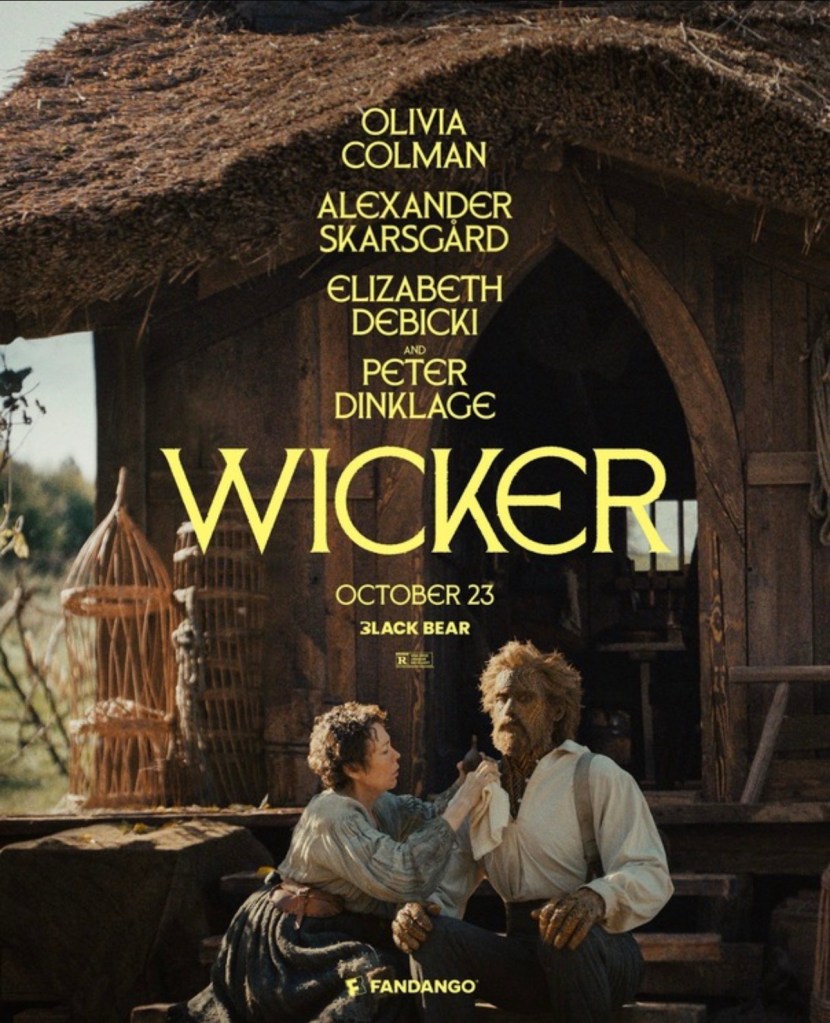
This seems to be the jumping-off point of Wicker. The film is about a lady who finds herself with a mystically animated spouse made from willow, reeds and hyacinth stems so it show the kind of life Elphie could expect with her own arbor paramour. In fact at the risk of being indelicate again, you could say this is also the movie’s jumping-on point as it does explore the physical side of their relationship. Abrasions it seems are not an issue.
The marketing has made a thing of this aspect of the story, but that is not really what it is about. It’s not Fifty Shades of Hay (although on googling that to see if I was the first person to come up with this play on words, I have discovered it is both the name of a Country band and a book about naming race horses). It actually bears more comparisons to movies such as Obsession as someone’s partner appears to be magically compelled to unconditionally love them, or even Mean Girls as the females in the village seek to punish this other woman for stepping out or her social position with unavoidably noticeable actions. What it is, is Sex, Lies and Rattan Cane Tape.
Unlike Wicked this leans into folktale traditions rather than fairytale ones. As such much of the reasoning and logic of events is sidestepped for the moral and the metaphor. There is no explanation for how this shrubsband is given tree will (I’ve looked those puns up and for good or for bad I think I can claim them as my own). With no time spent on pacts made with forest sprites or the like, the story is able to instead explore ideas around patriarchy and civic order. It is set in a historically and geographically non-specific pre-industrial village but has much to say about contemporary lives and male entitlement. Within this there is a gentle thread of gender equality as inspired by the lead female’s rejection of convention by taking a man outside of both the social and natural order, the other women start to want something more than their provincial life. This doesn’t go very far though. None of the women really gain any empowerment and the one that does, when she is introduced in the denouement, still appears to be under coercion and with no real sense of autonomy. She does teach a lesson about what these sexist men are buying into but she is still literally bought. It’s a thorny look at feminism.
Most interesting to me was the timber suitor at the heart of the tale. Here is a guy who has come into existence away from any influence from society and as such seems to present the natural state of humanity. He has no malice, no expectation, no mistrust or fear of others. He has no standoffishness or repression and possesses a great compassion without prejudice. He also has a huge capacity for kindness and love and little threshold for hate, even when there could be cause. He is still deeply heteronormative but you get the impression that even this might be fluid. It is an interesting piece of characterisation and despite his nature he is never sappy.
Crucially the movie is not preachy in any of this. It tells its story with wit and charm and the performances are highly entertaining from a range of familiar faces. The film is another showcase for Olivia Colman but is also a good ensemble piece. Wicker is most certainly a curio but one that marks writer/directors Alex Huston Fischer and Eleanor Wilson as ones to watch. The film may not turn out to be perennial but it does most certainly take root.

