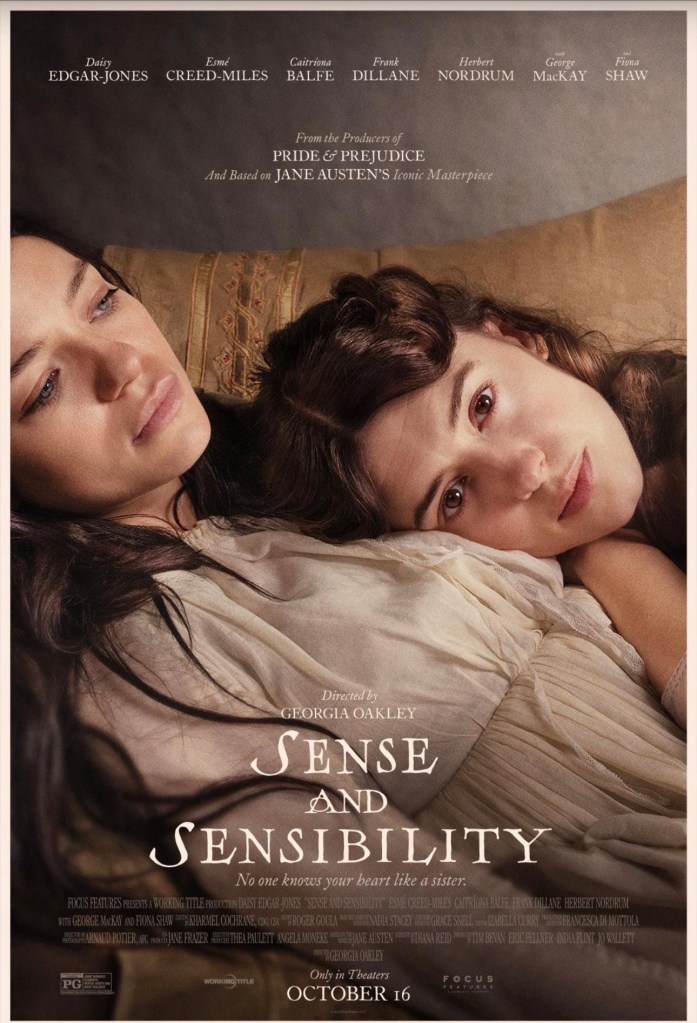
.
It’s been thirty one years since the Emma Thompson movie. To anyone who suggests we don’t need another Sensibility & Sensibility let me respond by reminding you that there have been four different retellings of Spider-Man since then and eight different Batmans. If those stories can stand to be constantly retold then it’s definitely been too long since we’ve seen a film adaptation of this.
The problem might be that the movie from 1995, also starring Kate Winslet, Hugh Grant and Alan Rickman and directed by Ang Lee is widely considered the ultimate version, almost as much as the BBC’s Pride & Prejudice from the same year. I’m sure the way that they are often thought of collectively has probably done Lee’s film a favour in cementing its untouchable reputation. It’s very good but it isn’t as definitive as Ehle and Firth as Elizabeth and Darcy. In fact Andrew Davis, who authored (co-authored) that famous series did Sense & Sensibility in 2008 as well and it is as not as fondly remembered, as either of that great mid nineties Austen doubled whammy.
A comparison here then is inevitable. Let me start by telling you that this new one, from director Georgia Oakley, doesn’t actually feel much like Jane Austen at all, let alone any other production of this particular novel. This is actually quite remarkable because it is very faithful to the source material but somehow has shaken off the tropes of all the other Austen adaptations that have effectively made them a genre of their own. Even Pride & Prejudice & Zombies or the much maligned Dakota Johnson version of Persuasion didn’t manage this and it is fair to say they took some pretty big swings (and memorably some big swigs in the case of the latter – I actually liked that movie).
This individuality is definitely to its credit as it has made the writer’s work feel fresh in a way it’s not done for decades. In some ways it comes over as a little muted though, at least at the start. It strives for realism but for a story that is named for the contrasting emotions of its two leading characters, it is initially a bit impassive and detached. Then midway through it totally goes the other way. I went with this second half more but it feels a bit imbalanced. Both Daisy Edgar Jones and Esme Creed Miles are excellent as Elinor and Marianne but Creed Miles almost goes a bit Nikki from Obsession at one point and then almost changes back as fast too.
Both actors are in their twenties which works better than it did with Thompson and Winslet who are in reality sixteen years apart. Interestingly Colonel Brandon comes across as a bit young here but that is only in comparison to Rickman’s portrayal. In the novel this older man is only in his thirties as he is here but Marianne is sixteen. They’ve changed this last aspect again for obvious reasons but have not aged him up a decade to match. This makes their dynamic quite different and they’ve changed some of the elements of his back story to go along with this reduced age difference. The biggest alteration to the book also occurs around Brandon and Willoughby but I’ll let you discover that for yourself, other than to say it heavily reminded me of a similar moment in Hamilton. There’s some not of the period dancing too.
This notwithstanding, there is as much for Austen purists to appreciate here as not. It isn’t as memorable or iconic as previous versions of the story, in particular that one even with its limitations, and it is far from being the best adaptation of this writer’s work. Neither is it Emerald Fennell’s Wuthering Heights though, which is a good thing. It is actually almost as preoccupied with its shot composition, lighting and production design as that movie but in a more measured way.
It’s a tiny bit of a task in places then but enjoyable; toll and tolerability if you like.

