.
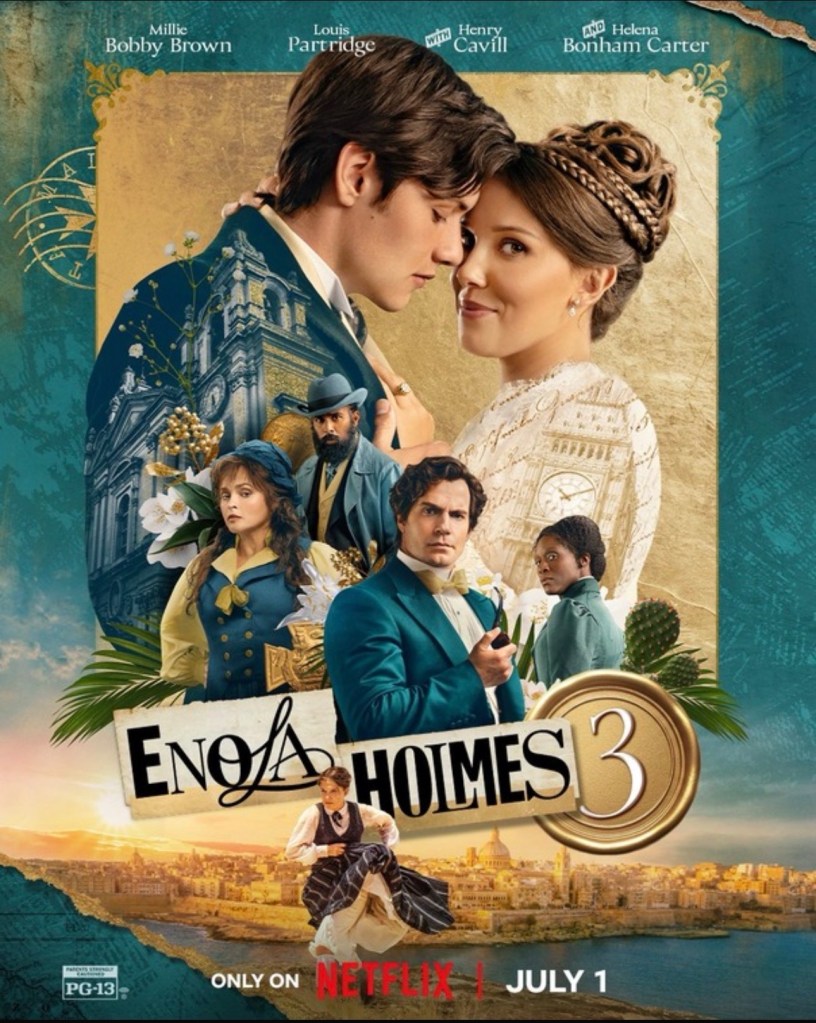
This is the latest part of Netflix’s successful series depicting the adventures of Sherlock Holmes’ little sister. The character, a creation of writer Nancy Springer rather than Conan Doyle, is played by the studio’s biggest star Millie Bobbie Brown (she and Adam Sandler have ongoing production deals with the streamer but while his is more lucrative, hers is more high profile) and it marks, almost certainly, the end of a big trilogy which this company have not managed as many times as I’m sure they’d have liked. Their All the Boys and Kissing Booth series ran to three but were much smaller budget movies and there are the Fear Street films but these were made as one project released over consecutive weeks so the existence of each instalment was never dependent on viewing figures and audience interest. It is fair to say then that Enola Holmes 3, also starring Henry Cavill and Helena Bonham Carter who like Brown have almost got signature roles out it (at least for younger audiences) is a pretty big deal for the people behind the iconic read N. Rarely before, perhaps only with Stranger Things, has the two tone tu dum drum roll that has become their audio trademark been so well earned.
Yet watching film this I wondered if in some respects it might have been more suited to Disney because Enola Holmes 3 is a bit of a ride and it presents a very theme park version of Victorian England. There is good and bad in all of this; the pace of the movie is exciting but it might trip over itself a bit. Similarly, the handling of history tries to be appropriately revisionist but comes across slightly cod, whereas the costumes, with their twist on 19th century styling, are wonderful.
As much as it mark a step up for Netflix, this is not the best Enola Holmes. The move away from the UK to Malta as a location is suitably epic and it gives the story a sunnier feel, in every sense, but the grime of London has long been associated with this literary lineage. Enola came from a bucolic background to the harsh realities of the streets regularly patrolled by her famous brother and that felt quite key to who she is. Taking her back outside, albeit in a very different climate, is still going back. The narrative actually deals with her suffering some loss of herself so the setting does work in that respect but in the process the audience might be losing something too.
The fourth wall breaking worked better before as well, when it made us as the viewer her companion; her Doctor Watson, but she’s not such a solitary player anymore. The Doctor Watson in this movie, for the first time, is actually Doctor Watson. Here the asides to camera are just another thing to take in when you’re focusing on something else, literally like someone trying to talk to you on this figurative rollercoaster.
The one person Enola has had along with her all the way is Louis Partridge’s Tewksbury. He and his family are key to the plot again here, as they were in the first and best of these films, but for much of the plot it seems they don’t really know what to do with him. He is largely ineffectual for much of the running time, operating just as the love interest and while I didn’t hate this reversal of traditional Hollywood gender roles, he could have been more than this. The romance, that reaches its apex here, has never been the best thing about their dynamic; they have better chemistry as adventurers than they do as lovers. There is a moment where to two of them go for an amorous moonlight swim that is a welcome break in the frenetic plot but seems odd when their investigation should demand a higher sense of urgency.
In the end Enola Holmes is a bright and engaging romp that does cement the series’ bonafide feminist sensibilities. There is a female Moriarty too who I had totally forgotten was also in the second, and arguably the weakest, movie. If you have enjoyed the other films, especially if you are one of the teenage girls they are made for, then there is nothing here that will disappoint. Even though I have criticisms, I wasn’t disappointed either. The Enola Holmes trilogy is a solid series of movies with an iconic lead character and an affectionate regard for all of its source material. Cavill himself is a good Sherlock and the character’s legacy is honoured and extended. They’ve certainly done a better job of introducing a sister to this literary family than Mark Gatiss and Steven Moffat did. Netflix should be pleased with themselves.

