.
The premise of this film immediately put me in mind of a running sketch that was part of The Two Ronnies TV show in the 1980s. Titled The Worm That Turned it depicted an alternate future where, following the rise of Margaret Thatcher, females had become the dominant gender in society and Britain was now an oestrogen fuelled oppressive regime. It is of course a bit misjudged by modern standards; it is slightly homophobic and unsurprisingly a little sexist with the all woman secret police parading the streets in military issue high books and hot pants, but it is witty and quite well observed.
You can see the opening of it here but the whole thing has been edited together as one 80 minute movie on YouTube if care to take an interesting walk through UK TV history.
.
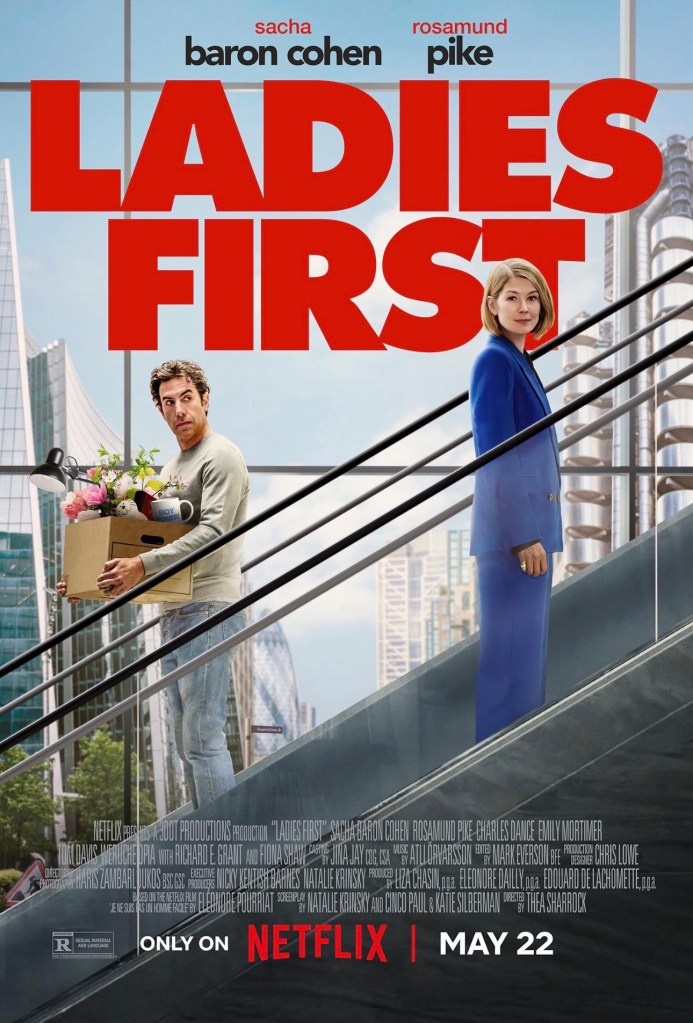
This new Netflix film explores similar ideas but does so with a fantasy premise à la Big and Freaky Friday (a concept which was nicely lampooned in Amy Schumer’s I Feel Pretty) where the protagonist wakes up one day to find themselves living a different reality. Here it is Sacha Baron Cohen’s boorish advertising agency CEO who is forced to live in a world where the gender roles are reversed, his only hope of escape is to succeed as a man in this matriarchal world and maybe learn a few lessons and truths along the way. If that sounds bad to you then you don’t even know. Ladies First is awful.
What was smart about The Worm That Turned is that the traits of men and women stayed the same. The males were forced to wear dresses but they did not suddenly become feminine. Ladies First on the other hand depicts most of the women as grossly masculine and the men as exaggeratedly girly, and while it is clearly trying (and failing) to get laughs out of this it is lazy storytelling. It basically assumes that the way people behave as genders is entirely nurture not nature and posits the idea that if women had long been given all of the opportunities then they would behave exactly like the worse kind of men. You might accuse me of overthinking this, and it is possible I’d be more forgiving if the movie were not so laboured and painfully unfunny, but there is a problem with this as an idea.
First off, the way men and women are presented here is so painfully out of date. Notions of gender have changed in recent decades and while sexism most certainly still exists, to pigeonhole behaviours and attitudes in such a black and white fashion feels odd in 2026. Not only are there more people actively living outside of the parameters dictated by birth and expectation (which might or might not be nodded to with one cast member, and I’m fine with either because I’d rather it wasn’t a big deal) but humans generally, at least in the Western culture, do not really fit into these boxes anymore, if they ever genuinely did – not in real life and not in how they are now presented in contemporary pop culture.
There is a psychological think piece to put together around this. If the attributes that women typically have had lead to them creating a society where men were historically considered an inferior gender rather than them then would we have ended up with a society where everything existed in parallel, only with males being the ones underpaid, judged on their looks, expected to stay at home with the children and given fewer opportunities. Similarly would they become emotional, overly tactile, obsessed with their hair and their cats while women all become cold, incommunicative, selfish, repressed and lecherous. Any time spent considering this would probably lead you to the conclusion no but whether that be the case or not, this movie sees it as a done deal. You might argue that this is not the place for such debate but if Ronnie Corbett and Ronnie Barker could ponder on this thirty years ago then why shouldn’t we expect it now. Where there should be sophistication in the screenplay there is just smugness and where we need command of the material we find over confidence. Their feminist observations are limited in scope like the furthest they could get was ‘Men are from Margate, Women are from Barrow-in-Furness’ and they’ve got nothing to say that hasn’t already been said, and said much better. #MeTooLittleTooLate. It is at best reductive and at worst demeaning in how it deals with both genders as well.
I was surprised to see that this comes from a female director and two female writers. Thea Sharrock worked on Wicked Little Letters and Me Before You which had fully rounded female characters, and Natalie Krinsky wrote The Broken Hearts Gallery which itself was an insightful relationship comedy. Most remarkably Katie Silberman was one of the creative forces behind Booksmart which gave us the best depiction of female friendships since Thelma & Louise and was the most brilliantly funny movie of the last ten years. I don’t know what has gone wrong with this one.
What’s worse is the talent being squandered on the screen. Rosamund Pike is currently in the West End in Inter Alia which is a play that explores masculinity and society with astonishing dignity and intelligence, and Pike is superb in it showing without argument that she is better than this. Then there is Fiona Shaw who is required to do things that are most certainly beneath her. Emily Mortimer somehow comes out okay because I think she captures something of what a woman might be like in this world with her pragmatism and focus (and some flatulence), and Tom Davis is properly amusing in a performance that is somehow affectionate and more honest in how it switches the gender roles than anything else in the film. Richard E. Grant, Charles Dance and Bill Paterson do not fair as well. In respect of Baron Cohen, I don’t blame him because I know he can act but he is simply terrible in the lead role. I would say they should have got someone else but I wouldn’t have wished any of this on anyone.
The film is an adaptation of a French movie from 2018, itself a Netflix production, and I’m almost curious to watch that to see how it compares. Considering how I resent the hour and a half that I gave this though I know that’s unlikely to happen. To anyone interested in that I, without hesitation, say after you.

