
.
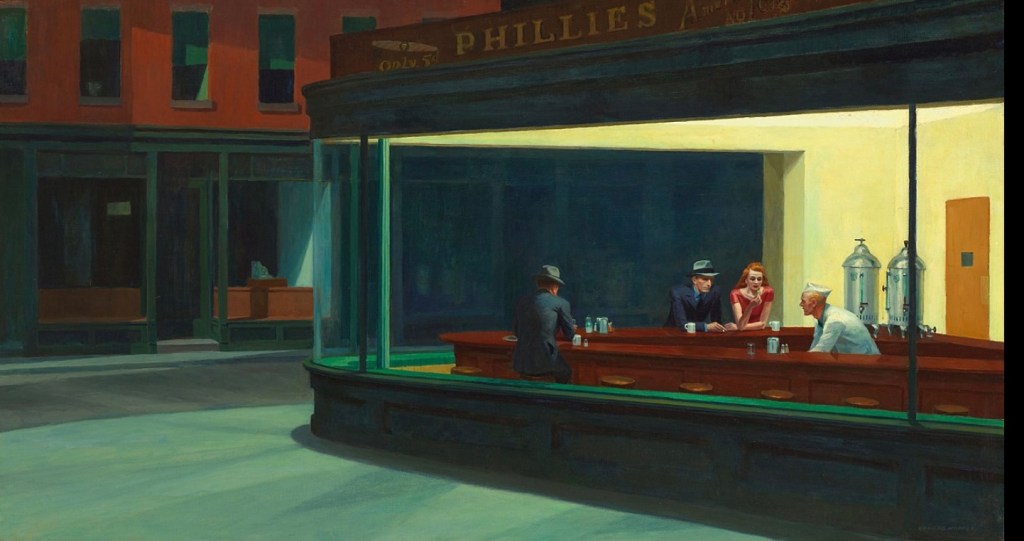
It is interesting that Nosferatu has become its own thing. The original 1922 movie was an unauthorised German adaptation of Dracula, just twenty five years after its publication, that referenced Bram Stoker’s novel but changed character names and locations as well as ultimately taking the story in a slightly different direction. Stoker’s widow actually sued the film company resulting in an order to destroy all copies of the finished work but a few survived which is why we still have it today. Nosferatu itself has now been remade three times though. It’s like revering Gottfried Helnwein’s Boulevard of Broken Dreams, featuring Marilyn Monroe, Humphrey Bogart, James Dean and Elvis Presley sitting in that cafe rather than the Edward Hopper’s painting that it imitated, or even that Kermit and Miss Piggy version of Grant Wood’s American Gothic.
.

.
.

.
To be fair, with or without the rights to Stoker’s original book, 1922’s Nosferatu, directed by Friedrich Wilhelm Murnau, is a masterpiece of early cinema. The imagery was incredible and it even introduced some of its own lasting vampire lore. The idea that these creatures are vulnerable to sunlight came from here rather than its stolen source material. Werner Herzog’s 1979 version is also great and there was the movie Shadow of the Vampire as well, about the making of Murnau’s film, which leans into the same sensibilities. (The other remake is an odd low budget one that actually came out last year with absolutely no fanfare whatsoever.) One way or another Nosferatu, like that Miss Piggy picture, has stepped out from the shadow of Dracula.
Part of the reason is that Nosferatu in all its incarnations has always had a distinct identity. This has always been a quite gnarly and grimy telling of Stoker’s story. At no point here does the monstrous title character transform into a dashing paramour. He is still all about seducing young women but remains a grizzled figure of horror throughout. This film’s director Robert Eggers has long shown an interest in this kind of aesthetic so this was presumably his attraction to the project. With only three previous movies Eggers has already established himself as one of Hollywood’s biggest directors of scary movies (which is probably why last year’s adaptation slunk back into the darkness) and he certainly likes to present distasteful images on screen. The very end of the Nosferatu narrative offers a particular opportunity here and Eggers has most decidedly taken it. The final scene places its gruesome and misshapen vampiric demon in a particular position that none of the previous versions have (let’s just say he has always risen from here before the end) and it is a memorably nasty way to conclude the film.
In answer to the question ‘who wanted another remake of Murnau’s classic movie?’, then ‘Robert Eggers did’ is your main response. We have this film because this director wanted us to. The real question has to be is this enough? Personally I’m not sure. There is no denying it is visually powerful and the performances are very impressive. Lily Rose Depp is certainly a standout and proves herself to be an incredibly physical actor. I got a bit annoyed with Aaron Taylor Johnson’s character though and it is quite slow in places. Willem Dafoe’s thing is becoming a bit of a schtick too. He needs something as good as The Florida Project again. (Incidentally Dafoe was in Shadow of the Vampire as well.) Also while it is nasty it is never scary. The Witch, which remains my favourite of Eggers’ movies, managed both but this doesn’t seem to want to. The original was more frightening than this and that was made 102 years ago. Eggers is not the kind of filmmaker to go for jump scares but he seems more interested in spooky images than building tension. There is one bit in the film involving two little girls that could have really ratcheted up the scares before its resolution but neglects to do so.
Perhaps unsurprisingly considering this movies pedigree, I spent most of the time comparing it to Dracula. I’m not a big fan of Coppola’s film but I do like the book and being more familiar with that than this (I’ve seen the 1922 and 1979 films but not recently) I was distracted by working out who was who and where the stories combined and diverged. I’m sure a lot of people will connect with this more than I did and I think I would rather still have this than another straight version of Stoker but I don’t really think I needed either. The thing that has marked Robert Eggers out up until now is his strong originality and although he puts his mark on this effectively ultimately this is what it was always going to be, just another copy. Frankly we’ve got too many of those in cinema right now.
 The Not Left Handed Film Guide