.
“It struck me as pretty ridiculous to be called Mr. Darcy and to stand on your own looking snooty at a party. It’s like being called Heathcliff and insisting on spending the entire evening in the garden, shouting “Cathy” and banging your head against a tree.”
This is a passage from the opening chapters of Bridget Jones’s Diary which wittily and succinctly highlights what has long been considered the difference between the works of Austen and the Brontës.
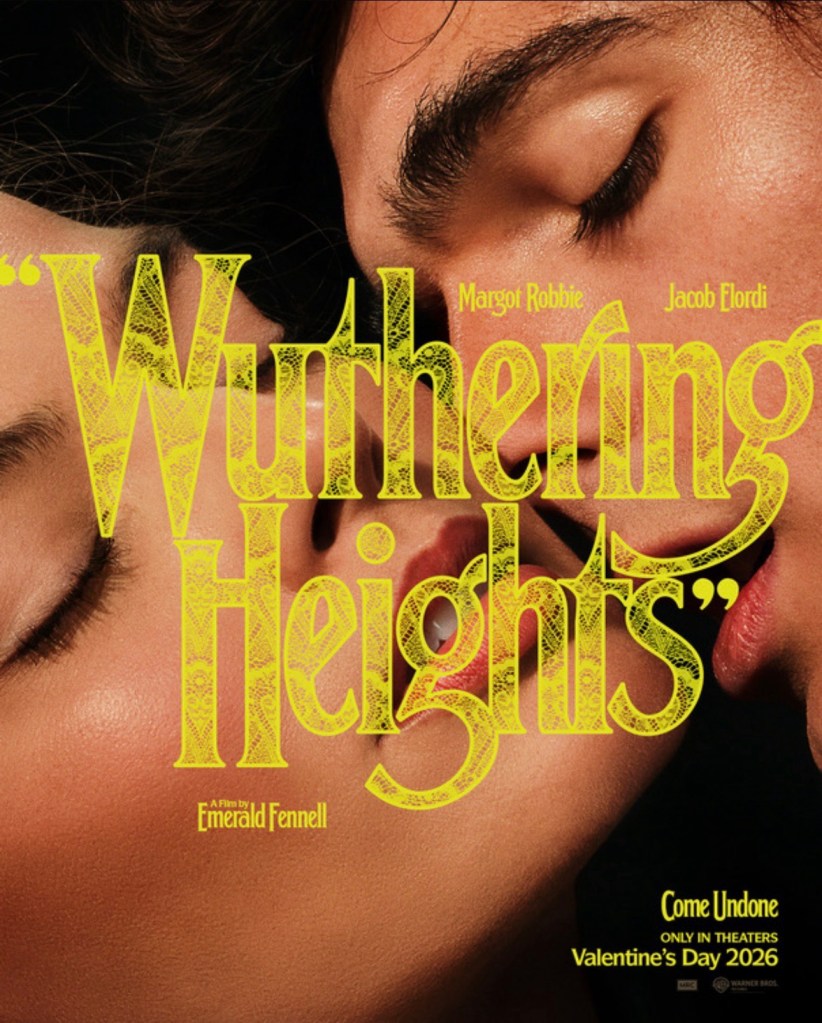
To some extent this new adaptation by Emerald Fennell both leans into and away from this cliche. Her ‘lovers’ are still unrefined and shaped by the wild countryside in which they were raised but here their passion is more broody than screamy. There is banging and there is wood but not in a way that involves many trees.
This film has had some pretty poor reviews. I can understand this but it is not a bad movie. It might not give some people what they want from it but that’s not the same thing. There was always going to be a bit of a pile on with this. It takes an already divisive classic novel, the argument around which (as Helen Fielding was well aware) was as key to your identity as your feelings of preference around Oasis or Blur, or cats and dogs. It is also the work of an audacious female director with a cast featuring two of Hollywood’s hottest properties, and these are things that some critics are inclined scoff at.
I don’t think the write ups are a result of wanting to shake a few perceived pedestals though, not entirely. The fact is that if you love the source material then there is so much of it jettisoned here that some disappointment is inevitable. If, on the other hand you are not a fan of Emily Brontë’s work then the things you take against in it are probably the same aspects that are put front and centre here. To have any hope of appreciating this you have to take it entirely on its own merits as it is totally its own thing; flawed but also exceptional.
What Fennell has done is strip the novel down to its absolute bare bones. Major characters have been left out, events have been truncated, side plots have been ignored and what is left is a story of two people in Georgian Yorkshire who are obsessed with one another and not afraid to hurt each other and those around them because they cannot be together as they want to be. The director has said that she wanted audiences to feel the same way about this as she did when as a fourteen year old she first read the book, and she seems to have tried to meet this aim by making it for, or as if she herself is still, a fourteen year old girl. Narratively it is not very sophisticated and there is very little nuance. What it also lacks is any sense of realism. In fact it almost plays out like it is a metaphor for something without it being clear what. Unless it is all just supposed to represent the idea of feeling distractedly horny. Yep, the big aspect that has been added is the sex. This is not a Heathcliff and Cathy stalking around one another in polite society, unable to connect because they are married to other people; these two are having a full on affair. Similarly while Nelly is the only character to have any additional depth, a number of them now have previously undocumented kinks.
All of this does make it harder to connect with emotionally. The Valentine’s Day marketing is selling this as a romantic story but it doesn’t work in this way at all (the story never has). The scenes with Cathy and Heathcliff as children are the most effecting, and Charlotte Mellington and Owen Cooper are great in the roles, but when Margot Robbie and Jacob Elordi step into the duo’s adult shoes they are harder to root for. This is especially true when they are playing them in their early twenties and Robbie in particular does not convince as the petulant, entitled, unworldly woman just out of adolescence. When she discovers sex and instantly seems to age about a decade she becomes more compelling but I’m still not sure the casting is right.
Much has been said about how having Elordi play the foreign interloper to the Earnshaw family might be whitewashing but in the context of the story as presented here he isn’t supposed to be of any different heritage; he’s not picked up from the Liverpool docks having presumably just stowed away on some merchant ship, he just comes from the local town. Incidentally, with this and Frankenstein, Jacob Elordi seems to be working his way through the reading list from my university 19th Century English Lit module so I look forward to seeing him in Tess of the d’Urbervilles or Great Expectations next. (He’d make a good Joe Gargery.) He smoulders effectively enough here and he’s no whiter than Ralph Fiennes, Timothy Dalton, Tom Hardy or Lawrence Oliver who have all famously taken on the role as well. (My favourite version is still Andrea Arnold’s one though with Kaya Scodelario and James Howson, the latter of who is black.)
Interestingly it is Linton who is colour blind casted here with Shazad Latif taking on the typically insipid posh boy love rival. He is noble and kind but doesn’t register as much as his ward (changed from his sister in the book) Isabella. Alison Oliver might be the MVP here, moving from fumbling innocent to full on female thirst quicker than Cathy. In this adaptation she is more complicit in Heathcliff’s revenge marriage than she has been in any other screen version as well. She is a victim of horrid abuse as written but clearly Fennell as the creator of Promising Young Woman couldn’t endorse this in her male hero. As such we see him gaining fully informed consent before their weird misadventures in a dark but very amusing moment.
Where this Wuthering Heights truly succeeds is in the production design which is amazing. At a hundred and thirty six minutes it also draws you in for that full extended running time. It is never dull and does capture an innovative filmic vision which I have to celebrate. The soundtrack by Charlie xcx is also excellent. In fact if you view the whole thing as one long music video rather than a movie then it might work perfectly.
The movie isn’t shocking or sexy, which are the two things I believe it is intended to be, and I actually think the consummation of Heathcliff and Cathy’s relationship makes their subsequent actions less likely. Nonetheless I cannot deny how highly entertaining it all is and I do recommend it.
Having started with a quote, I’m inclined to end with one so I clearly have to turn to Kate Bush. Her song inspired by this tale included the lyrics:
“How could you leave me when I needed to possess you? I hated you, I loved you, too.”
I’m not sure I felt that strongly about this film’s respective highs and lows but overall I enjoyed it and think I will do so more on the repeat viewings which I think I’ll go for. Give it a go and make up your own mind.
 The Not Left Handed Film Guide