.
Anne Hathaway has five movies coming out this year but this is not one of them. I can’t be only one to wonder if Anna Hathaway has ever considered playing her famous namesake and if so she’s missed a big opportunity here. That said Jessie Buckley is brilliant in the role so it is hard to imagine it having gone to anyone else, even if Hathaway has a very particular claim on it.
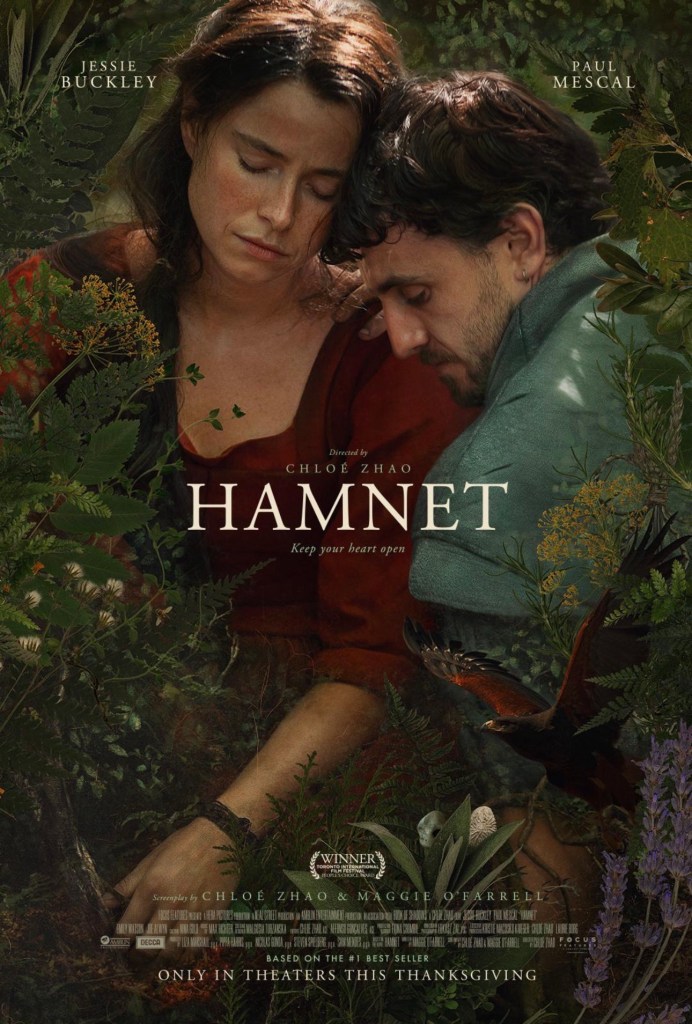
In her 2020 novel Hamnet, Maggie O’Farrell presented a very particular picture of Shakespeare’s wife. Under O’Farrell’s eye she is a free spirited and confident woman, emotionally connected to nature and not afraid to fight for what she wants. There is a captivating wildness to the character and in this screen adaptation Buckley suits this very well. This persona might have seemed forced coming from a lot of other actors but in Beast, Wild Rose, Misbehaviour, The Lost Daughter, Men, Women Talking and Wicked Little Letters Buckley has repeatedly made portrayals of this type of independent mindedness and female drive her own.
It is great that the book, and now the film, has taken this figure from history; long thought of as an aged and deserted spouse who stood in the way of her husband’s genius, and puts in her place a strong, supportive, much loved and wise character with a great amount of agency. It’s not a version exclusive to this story but it is probably best realised here.
In fact she’s not even called Anne Hathaway here; her surname is never mentioned and her first name is Agnes (pronounced ahn-yez). This is historically acceptable as it is apparently how her father is known to have addressed her but it also sets up the general habit the Tudors seemed to have of spelling and vocalising people’s titles in any number of ways as the mood took them. It’s an idea that this whole tale hangs on.
Again, O’Farrell was not the first to posit this but the narrative here is built around the idea than Hamnet and Hamlet are essentially the same appellation and that Shakespeare’s most famous play is heavily inspired by the preteen son he lost around the same time that he wrote it.
It is not known how the real Hamnet died and previous film All is Lost builds a different type of drama around it to how they do here. This is very much a fictionalised account of history but there is nothing that disputes any known facts and the story is a relatively simple but powerful one of love, family and bereavement. It is more than that thought because of course the play’s the thing.
I’ve always been a bit confused by the idea that Hamlet is connected to this tragedy in Shakespeare’s family as the plot seems incongruous and like many of the bard’s works it was expanded from existing origins. It is sentiments, speeches and motivations from it that are expressions of the playwright’s own loss though and the way this is laid out in Hamnet is actually beautiful. The first part of the movie sees a young couple building a life, then the loss of a life threatens this. Then we see how a populist work of art creates healing. The final scenes as Agnes reacts to her husband’s masterpiece playing out for the very first time is for me the strength of the film but it would not have worked as well without what came before it. This is Buckley’s show but Paul Mescal is as brilliant in humanising Stratford’s most famous forbear as she is in reclaiming his much maligned partner. History is genuinely brought alive.
Director Chloé Zhao won the Oscar for Nomadland in 2021 but this is a better movie. That film was about loss and human connection but this deals with similar notions in a more intimate and touching way, while also managing the period setting and metaphysical themes. Crucially, while showing him as a husband and father, this movie also highlights William Shakespeare’s genius. The context given to the scenes we see from Hamlet gives them new power but the performances are also great. I saw that there is a new production of Romeo & Juliet playing in London this Summer with Sadie Sink and Noah Jupe and this establishes Jupe’s Shakespeare credentials perfectly with his essaying of the onscreen Hamlet, made up to look like the child who has passed. That child appropriately and no less skilfully is actually played by Jupe’s younger brother Jacobi.
Hamnet is of course heartbreaking in places but it brings its own catharsis and as a whole is an uplifting and wonderful experience. Jessie Buckley is excellent and frankly it will be hard for anyone else to play Hathaway now.
Is it too late for Jane Seymour to play Henry VIII’s third wife. Apparently there was also a vaudeville singer called Bill Murray in the early 1900s. Maybe there an interesting opportunity there.
 The Not Left Handed Film Guide