.
In a modern Hollywood seemingly afraid of committing any large amounts of money to brand new characters and stories, the idea of ‘legacy’ has become synonymous with any movie that gathered a decent enough crowd a few decades ago to maybe merit a sequel now. Some of these revamps have been successful (Star Wars VII, Top Gun 2), some have been lazy and misjudged (Independence Day 2, Beetlejuice Beetlejuice) and a few have even been artistically valuable (Blade Runner 2049, Doctor Sleep and 28 Years Later). The notion that these are all built on great works that have had a lasting impact on the medium of cinema, as the word would suggest, is pushing it though. (I mean who was asking for a follow up to The Craft or Space Jam?)
No, when we talk about legacy in this field it should be in association with people and projects that have genuinely shaped and influenced the art form. In terms of directors that are still working today there aren’t many that are afforded the reverence they deserve here. Scorsese perhaps and maybe Spielberg but even these guys are overlooked by a lot of young audiences as they scramble to show their cineaste credentials based on having seen Ten Things I Hate About You or the original Jumanji. Women, even now, are mentioned in this respect less still. I know this sounds slightly pompous and more than a bit curmudgeonly. Sorry, not sorry.
So it is then that I have my head in my hands as a new film by none other than Kathryn Bigelow gets a small theatrical release and then drops quietly on Netflix. Bigelow has been one of America’s best and most consistent filmmakers since the 80s, making high end blockbusters like Point Break and Blue Steel, arty but still populist movies like Strange Days and The Weight of Water, biting dramas like Detroit, genre pictures like Near Dark and of course the conflict thrillers she has become known for like Zero Dark Thirty and The Hurt Locker, the latter of which for what it’s worth lead to her becoming the first female recipient of the Oscar for Best Director. Her recent work has had an incredible verisimilitude that perhaps only Paul Greengrass comes close to matching and she is someone that truly has created a legacy, both in terms of what she has created and in relation to who and what she has inspired.
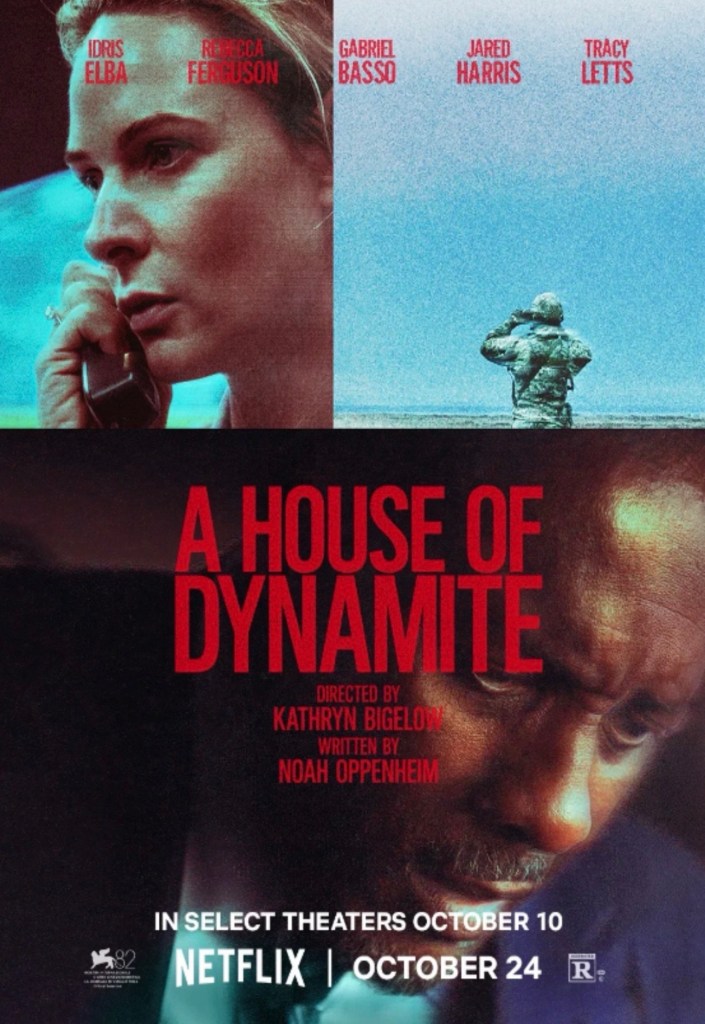
Her new movie A House of Dynamite (a title that sounds cheesy but totally works once you’ve watched it) depicts a theoretical event that is frighteningly relevant to everyone living on Planet Earth. There have been a number of films that deal with the risk of nuclear weapons being deployed including this Summer’s Mission: Impossible – Final Reckoning and Bigelow’s own K19: The Widowmaker. This covers what happens in the twenty minutes after one has been launched and unsurprisingly, because it is this and it is her, it does so in very sophisticated and sobering fashion. It is captivating and thrilling when it is dealing with the counter measures but terrifying when it gets to discussions of retaliation.
Bigelow has always had incredible command of her subject and never more than when dealing with those in command. In replaying its short time period three times from different parties perspectives, A House of Dynamite works its way all the way up to the Commander In Chief (who more follows the Obama model than any other). I have to admit that when it first jumps backwards, at the point the missile is about to hit, I was a little frustrated but the structure of the movie actually works brilliantly as it layers on details with each retelling. It means it can play out in real time but it also provides a good focus on those involved at each level. In this, some characters are revisited while others disappear from the last hour of the movie but everyone shines.
There a some big names in the cast, some of who only feature briefly but they are all exceptional. There are those who you know will always be good like Idris Elba, Tracey Letts and Jared Harris, others who are continuing their rise like Gabriel Basso, Greta Lee and Kaitlyn Dever and a few who you feel are finally getting some material worthy of their talents like Jonah Hauer-King and Hamilton alumni Renée Elise Goldsberry and Anthony Ramos. Together they are a very impressive ensemble. MVP is probably Rebecca Ferguson though as she perfectly portrays stoicism, responsibility and humanity as they battle against one another in meticulously planned for but unimaginable circumstances.
Shepherding it all is Bigelow though. This is her show and it totally builds on her reputation. She is not someone who makes movies regularly, it is eight years since her last one (but she’d reached normal retirement age even by then so she can work at whatever pace she wants), so I hope this brings her back to the conversation and introduces her to a new audience. This isn’t as explosive as The Hurt Locker, which arguably remains her best film, but I’m sure she’ll be up for making history at the Academy Awards again by possibly being the first woman to win Best Director twice (although it is a shame we’re having this conversation when there are still only three to have won it at all and only nine across ten movies to have even been nominated).
I definitely recommend this. I had been worried going in, having suffered my share of nuclear war anxiety same as anyone else back in the 80s. Even though this highlights how the sense that this fear has passed may be premature, it still isn’t too much though. It is scary for sure but in an appropriately measured way. The movie knows just what to show and unlike many of the other films that have been recently heralded as part of a legacy, it knows exactly when to stop.
 The Not Left Handed Film Guide