.
There’s no point in not addressing it; movies about disabilities often win awards. Daniel Day Lewis, Dustin Hoffman, Jamie Foxx, Eddie Redmayne and Julianne Moore all got their Oscars for playing differently abled people, as did Al Pacino for a role that definitely wasn’t his best. Then there’s Coda that took Best Picture when no one really expected it to.
A lot of these films are excellent to be fair, but even the relatively few that manage genuine authenticity, feel like they are courting these prizes at least little bit.
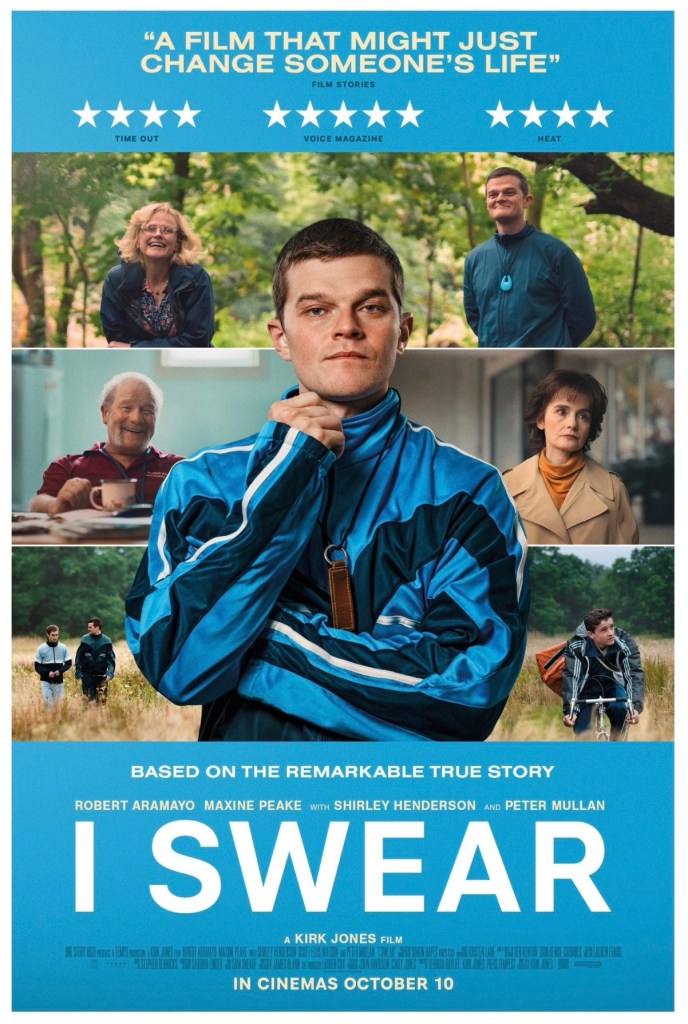
I Swear, which does tell the true story of a man living with a disability even though he himself rejects that label, does not come across in a way that seems to have this on it’s mind though. Rather it seems to exist more to raise awareness, just as its singular subject has done for the last few years of his life. This doesn’t mean it won’t be garlanded, indeed I hope it is, but this is apparently not among the priorities of those involved. Their intentions give the impression of being all the more altruistic.
The narrative centres on John Davidson who as a young teenager in the 1980s developed the largely unknown and almost entirely unrecognised condition of Tourettes Syndrome. In his case this was coupled with Coprolalia, which is the uncontrollable swearing that people nearly always associate with Tourettes even though it isn’t always a symptom. Seeing Davidson being victimised because of a lack of understanding and patience is often tough to watch but his success in rising above it and the support he starts to give those similarly affected is a beautifully cathartic counterpoint to this. The film is also able to occasionally find the humour in the condition but is always respectful, and the overall tone is nicely balanced. There is a scene with an adult John meeting a young girl with matching traits of Tourettes in the back of a car that is somehow heartbreaking, amusing and victorious all at the same time and it’s a powerful moment that director Kirk Jones makes look deceptively easy to capture. (It should be noted that the younger player here, Andrea Bisset, genuinely has Tourettes.)
The two actors that play John, newcomer Scott Ellis Watson who covers his adolescence and Robert Aramayo who portrays him from his twenties to his fifties, are both quite brilliant. (This is where the accolades will surely be directed.) They are supported wonderfully by Maxine Peake, Shirley Henderson and, reuniting with Aramayo after TV’s The Rings of Power, Peter Mullan, who with any luck will get some recognition too.
Interestingly the part of John Davidson’s life that does not feature is the six documentaries he was in, three of which are entirely about him, dating back to when he was 16. This movie is certainly not the first time his story has been told but in this instance this is not part of the story being told. You can see why this has been omitted but without this knowledge it is confusing as to where the real footage of him that plays over the closing credits comes from.
Filmicly this is quite a straight relaying of events. It does play with chronology a tiny amount but mostly this is an A to B to C biopic. There is skill in it though and Kirk has made the right choices around letting the moving story tell itself. It is partly this that contributes to the unassuming honesty of the movie but in the end it knows what it wants to say, and like its protagonist learns to, has an earned a lack of fear and no pretence in saying it.
 The Not Left Handed Film Guide