.
The trailer for this film proudly proclaims that it comes from the Francis Ford Coppola, the celebrated director of The Godfather, Apocalypse Now and The Conversation – and well it might as these are indeed three truly great works of cinema that each greatly influenced the medium when they came out in the seventies.
When they came out in the seventies.
Hmmm!
I don’t think it’s unfair to suggest that Coppola has not quite reached these same heights since 1979 and while there have been some good movies, there have been some clunkers too. No one is talking about Jack, Youth Without Youth and The Godfather III in the promos for this, that’s for sure.
On the one hand then you might think that this new film, financed entirely with his own money and not adhering to any kind of normal filmmaking conventions, is strong evidence of the man believing his own outdated hype. There is no denying that Megalopolis is indulgent and uncompromising, and certainly people have been quick to decry the hubris they believe is behind it.
I don’t think this is entirely fair though. Artistically this film does not totally work, but it is still the work of a seasoned director who knows the potential of cinema and is trying to do something original and inspiring. Coppola is most definitely not resting on his laurels here, or even trying to imitate his past success. Besides, it’s his cash, he can do what he likes and in many respects, like with Aronofsky’s Mother! and this months The Substance, there is something great about a movie this unconventional making into the multiplexes.
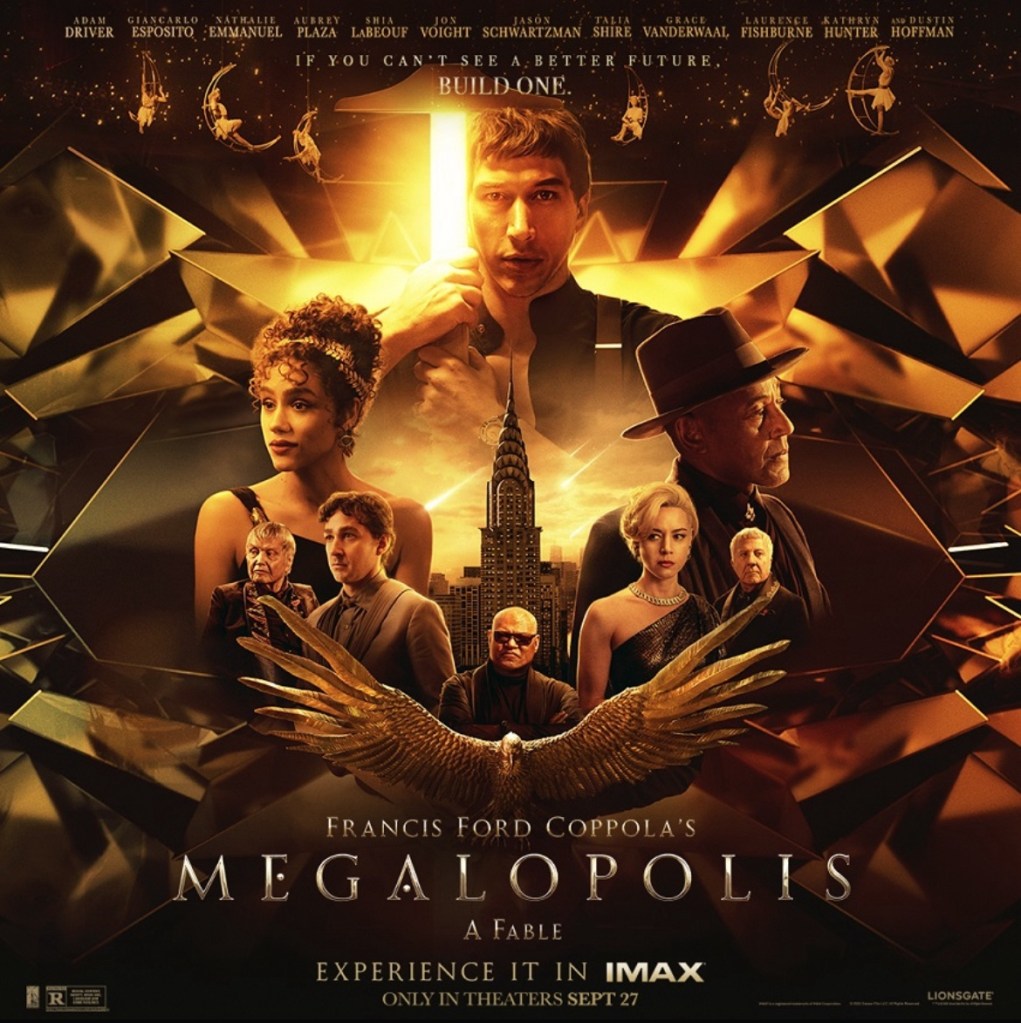
If it had been anyone other than Coppola this may not have got the same distribution but I also think that if this had come from a less high profile figure then the brickbats might not have come out in the same way. The critics have called this by turns a ‘bloated cartoon’, an ‘impenetrable mess’ and ‘a zero-star, wacko disaster’. One journalist even wryly labelled it ‘Megaflopolis’. In truth this is a staggeringly imaginative and visually spectacular work. The story centres around two key public figures in an alternate reality future Manhattan, here grandly called New Rome – taking its name and iconography from the ancient Italian Capital. Locked in conflict these two men have contrasting ideas about the future of their beloved municipality, and those circling around them with kind intent or their own malicious plans, are caught up in the resulting political turmoil. It’s all quite sophisticated in concept.
Sadly it is in its execution that it falls down. Amidst the elaborate design and ambition there is also a huge amount of affectation. It feels as though Coppola is aiming for Shakespeare or the great philosophers with his use of language and his examination of humanity but what was meant to be studious is too often supercilious. The whole thing is less like Plato and more like the Paris Olympic Opening Ceremony. It doesn’t have Philippe Katerine as a cobalt Bacchus but one of Shia LaBeouf’s outfits isn’t far off.
As well as LaBeouf the cast features Adam Driver, John Voight, Jason Schwartzman, Audrey Plaza, Laurence Fishburne and Talia Shire and they all must have seen something in this (apart maybe from the two of them that are Coppola’s family members). Maybe something has got lost in the final cut. There was clearly potential here but it appears to have lost in all the pregnant pauses, disjointed timelines and confused characterisation.
Ultimately this film has to be put down as a noble failure. It is a financial failure too; it has made barely a twelfth of what it cost. To be honest this was always going to be too inaccessible to be a box office sensation so if Coppola was expecting it to bank this might have been a little bumptious. He did the same thing in 1981, self funding One From the Heart, the follow up to his famous Vietnam epic, and he has literally been paying for it ever since.
Personally I hope he comes back from this more quickly. Megalopolis shows a side of him as an artist we’ve not previously seen and if this could be combined with the same command of storytelling he showed forty odd years ago then we could get something worthy of his original legacy. For all of its aspiration though, this is not that thing.
 The Not Left Handed Film Guide