.
In the past I have talked about stories on film that are pretty much left to tell themselves. In these cases, where the plot is commonly based on incredible real events, it often feels as though the writers and directors haven’t done anything too sophisticated or cinematically showy because they are confident that the straight narrative itself is enough. Essentially I was saying that making movies like Young Woman and the Sea, She Said and Dark Waters, either by accident or design, requires less skill. Certainly none of these have the flourish of Christopher Nolan’s Oppenheimer or the majesty of Milos Foreman’s Amadeus. I realise now though that in these cases I have been doing the filmmakers a disservice. Watching Lee it becomes clear that even with the compelling details of a person’s remarkable life, you can still get it very wrong.
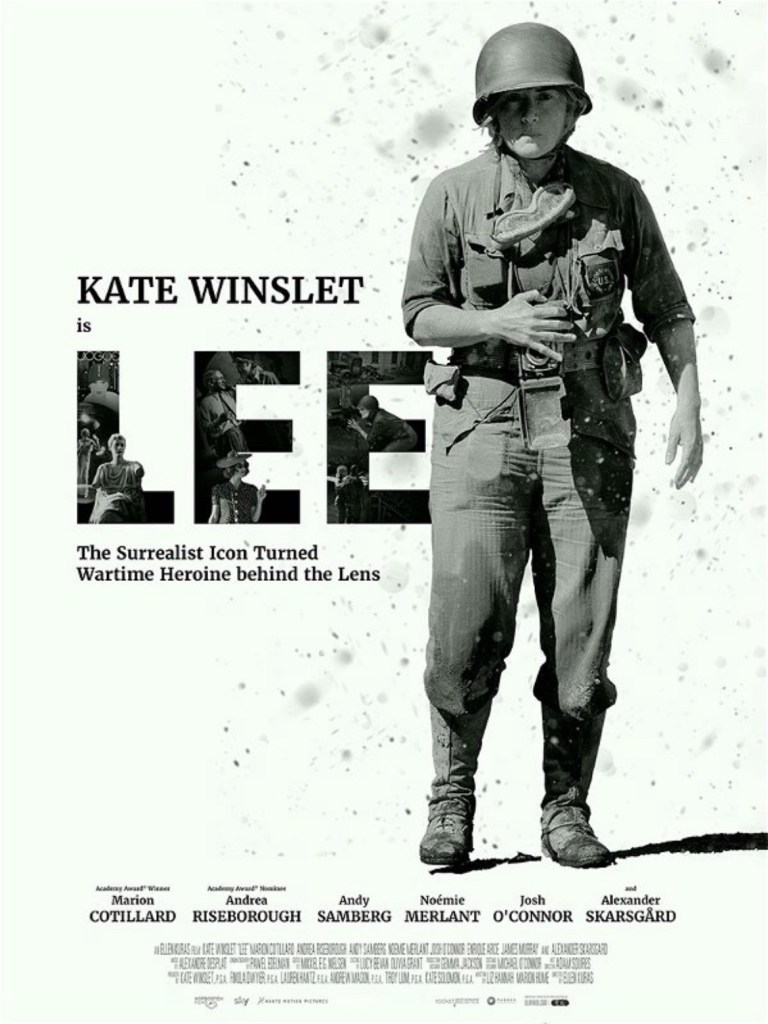
Okay, I have come out of the gate attacking this movie so let’s first highlight where it is succeeds. There are scenes in this film about the years famous female photographer Lee Miller spent documenting the effects of World War II that have real power and the performances, from Kate Winslet and Andy Samberg in particular, are strong. There are some other talented actors like Marion Cotillard, Josh O’Connor and Noémie Merlant who all get moments to shine but are largely sidelined, which I’m inclined to think might be weaker editing but let’s decide it’s just great casting for the smaller roles. The feminist themes are really well layered in as well. With a story so clearly centred on a woman who was determined to push herself into an area of work, as well as literal spaces where females were not allowed, this part could have been quite laboured. As it is, in the hands of Winslet and director Ellen Kuras it avoids any unnecessary drama and lands with an honesty and measured power.
Judged on its individual components, Lee is good then, but as a whole it is a disappointment. As it was playing out, the structure all just felt very staid and unadventurous and then at the very end the film presents the audience with a cliche so corny and predictable as to almost distract from everything that has come before. Sky, the production company behind this, are pushing it as a prestige picture but the way it is put together is just so lacking in innovation, from the tired framing device to the pedestrian plotting.
Part of the issue, but by no means all, is that this movie comes only five months after Alex Garland’s Civil War. That film was fictional, depicting a near future conflict across the USA, but also focuses on war photographers. Kirsten Dunst’s lead there, herself named Lee, is even compared to her famous predecessor from this film so comparisons are inevitable. What Civil War does over Winslet and Kuras’ movie, beyond maintaining incredible tension all the through, is properly scrutinise what drives someone in this profession. Lee does this to some extent, mostly through Winslet’s performance rather than anything in the script or direction, but nowhere near to the same fascinating extent as Garland’s movie.
I would still say Lee is worth watching, the story does indeed tell itself. In this case though it’s isn’t a case of the filmmakers getting out of the way, oh that they would. Lee is in cinemas now and will no doubt be available to watch at home on its studio’s streaming channel soon. Maybe wait until then.
 The Not Left Handed Film Guide