.
I love the end of this movie,
it is just so incredibly derivative.
It’s perfect.
There have been any number of meta movies over the years, from the obvious ones like Deadpool, Spaceballs, Monty Python and the Holy Grail and Adaptation to films like Scream, The Truman Show and La La Land which tell knowing stories without breaking the fourth wall. American Fiction eats itself in particularly interesting and subtle ways though, taking notions of being self referential into new areas and to a point where it’s denouement is perfectly both totally unoriginal and smartly inventive.
Essentially the film does for the literary world what other films have done for Hollywood and with its parallel commentary on cliched depictions of black culture it could have just as easily been called Da Playa or even Ghetto Shorty. It actually owes a big debt to Travolta and Sonnenfeld’s 1995 Elmore Leonard adaptation, but as suggested it is bulletproof to all accusations of being overly imitative by the time the credits roll.
This film too is adapted from a book and there is something of life contrasting with art associated with this too. In the movie Jeffrey Wright’s academic author impetuously writes a novel parodying the worst excesses of white readers’ desire to devour stories about young black men caught in spirals of crime, toting hand cannons and being at war with the police and state. Having only done this to make a point and trying to kill it when it becomes a sudden success he suggests a bluntly offensive one word name for the work that he is sure society will never accept only for the publishers and the public to lap it up. Apparently writer Percival Everett and certainly filmmaker Cord Jefferson wanted to use the same title but in reality the companies they were working with nixed it.
What is also so good about American Fiction is how it builds. Everything I’ve said about it being meta isn’t initially evident which means before it pulls you out of the story, it totally draws you in. There is some quite touching family drama in here too. The performances are all engaging as well, from Jeffrey Wright and Sterling K. Brown, who are Oscar nominated, and from Tracee Ellis Ross who isn’t. Ross brings the film a real energy and it is a shame not to see her recognised like her male co-stars.
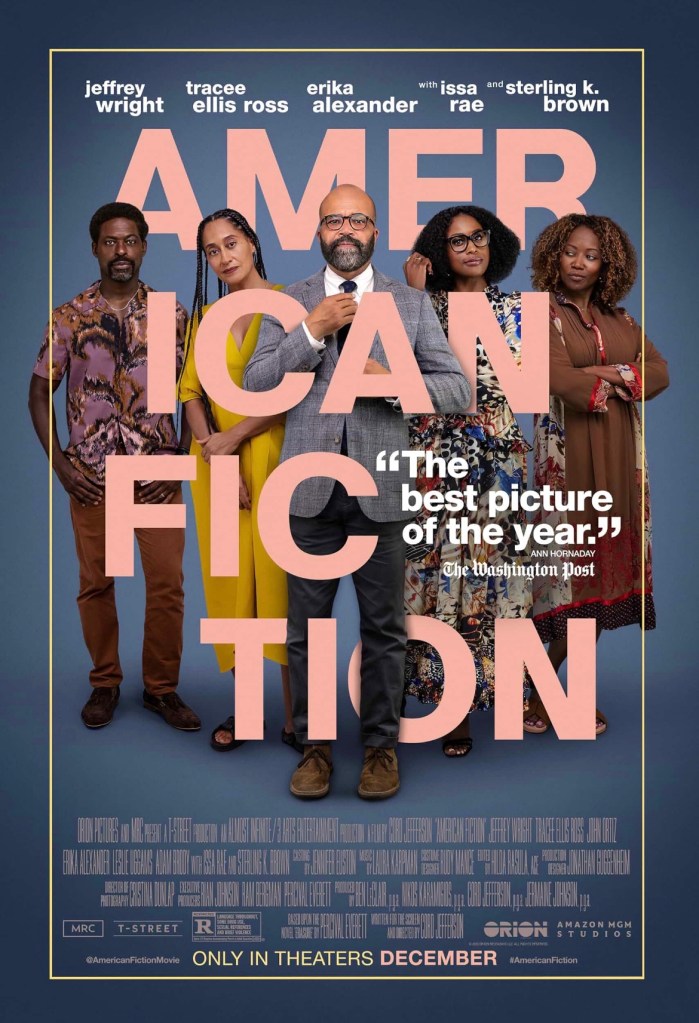
This is a really smart movie then and in its exploration of popular depictions of black identities it has something important to say. It isn’t the best picture of the year, as the Washington Post quote declares on the poster but it is worth seeing, because of and not despite the fact that you might feel like you’ve seen aspects of it before.
.
The Ripley Factor:
I’ve already mentioned what Tracee Ellis Ross brings to the picture but actually all voices of reason in this film are female. As well as Ross who plays the protagonist’s sister there is Issa Rae as a rival author, Erika Alexander as the love interest and Myra Lucretia Taylor as the house keeper. There are all supporting characters in a man’s story but bring kindness, humility and wisdom where the male characters don’t.
 The Not Left Handed Film Guide