.
This idea of turning films into stage musicals then remaking them as film musicals is not a new one. In fact let’s not call it an idea at all, let’s call it a trend, as now that the bankability of such projects is well established I’m not sure how much postulation and judgment is required around them any more. Each one comes with a certain amount of inevitability.
Either way, it’s not a recent thing. It didn’t even start with The Producers and Hairspray in the mid 2000s. This is the route that Little Shop of Horrors went, as indeed did The Sound of Music which was based on a lesser known 1956 German film called The Trapp Family.
Still, it does feel like there a few of these coming out at the moment with there currently being two released here in the UK on consecutive weeks; this now and The Colour Purple on Friday. Sunset Boulevard and Spamalot are apparently both on the way as well and second screen versions of such varied projects such as The Bodyguard, Big, Billy Elliot, Bend it Like Beckham, Beetlejuice and Back to the Future all may well follow having had successful West End or Broadway adaptations (and that’s just the Bs).
To be fair, most don’t bring much extra other than the songs. Tim Minchin’s Matilda totally changed the whole approach to the story, but that was probably born more of the book than Danny DeVito’s movie. Should his version of Groundhog Day ever go before the camera then you’ll see something different there too. Generally though the transition steals as much as it adds. (There’s are no dogs or skateboards in Back to the Future the Musical, for example.)
In terms of what is missing from this Mean Girls then, we don’t get the occasional voice overs or the great trust fall gag with Gretchen and Karen, and oddly this time there is an absence of any real redemption for Regina. She’s not so much changed at the end as high on pain meds. I know this was referenced in the final scenes in the original but this time it defines all of her closing moments. Also gone though is the racial stereotyping and latent homophobia which is clearly great. This time Janis’ sexuality isn’t a poisonous rumour that’s definitively denied at the end, it’s just a part of who she is.
The twenty year time difference has sorted out some of the less enlightened aspects of the story then (mathlete Kevin’s strange OTT sexual behaviour surprisingly stays in) but it has also taken away the satire. If the original was calling out turn of the millennium culture then so this one is calling out turn of the millennium culture. There is a nice point made about teen girls in fancy dress in the Halloween song but even that isn’t as timely as it was in 2017 when the musical first debuted.
Without the tunes then, most of the appeal of this version of Mean Girls is the same as that of the first one. Fortunately the 2004 Mean Girls is a really good film so that appeal is not on short supply. The humour and characterisation is all still here and the familiar lines still land. I’ve made a few references to plot points here but have done so without fear of spoilers because this film, like the stage musical, expects you to have seen the last one. This much is clear in the reference to the plot’s biggest shock moment right in the opening song.
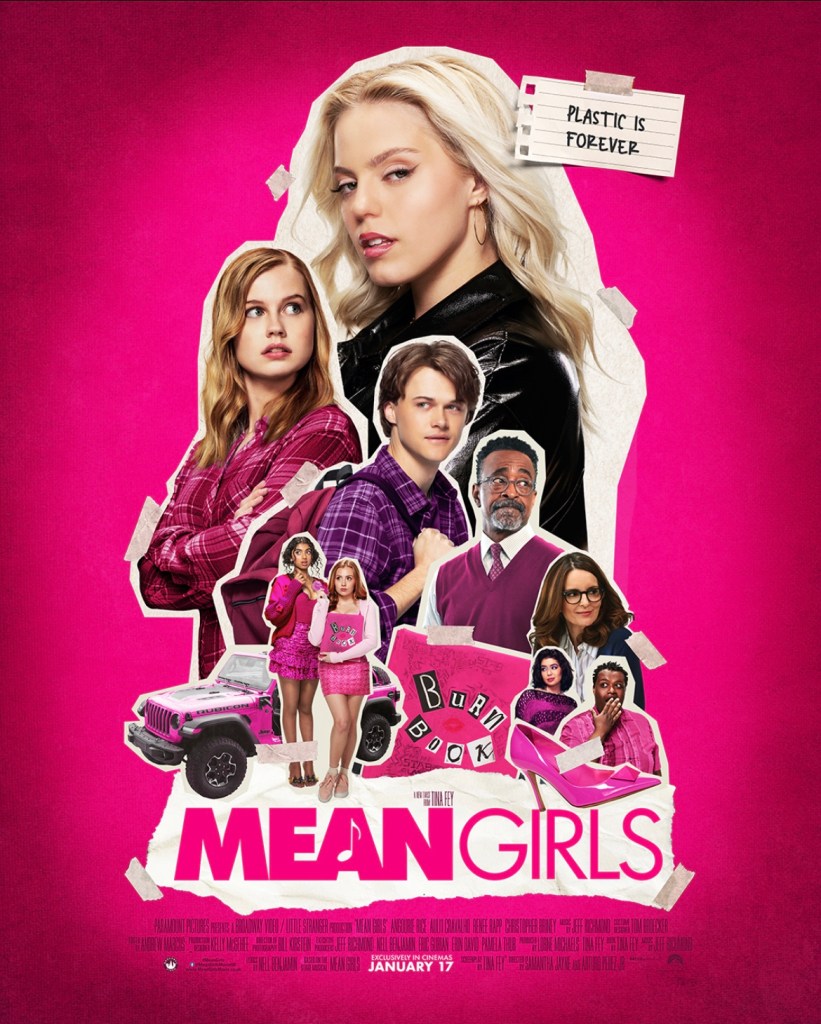
While comparable to those we saw two decades ago then, the performances are not in any way inferior. The original made stars of many of it’s lead cast and so I am sure will this one. Angourie Rice has been around in various notable films and TV shows since The Nice Guys and was especially good in Black Mirror, Every Day and Mare of Easttown, but this is her first high profile lead and I’m sure it won’t be her last. Auli’i Cravalho who burst into the world of cinema at sixteen playing Moana is also now only getting her face on screen like she deserves as well, and is possibly the best thing in this movie. If anyone challenges her for this it is Reneé Rapp who maybe manages to be even more Regina George than Rachel McAdams was but Avantika Vandanapu and Bebe Wood are also excellent as the other plastics.
I’ve been dancing round it but the songs and the dancing around them are also great. Their inclusion does actually change the feel of the whole thing quite a lot and while I’ve not come away humming any of them, the staging of each is tremendous fun.
Relentless as the transferring of movies to stage and the back to cinema is then (Call Me By Your Name, Easy A and The Perks of Being a Wallflower must all be in gestation somewhere), if they come out like this then it’s hard to complain.
.
The Ripley Factor:
While Mean Girls is female centric, it’s never been particularly feminist. The young women in it are shown to be vindicated, gossipy, petty and boy obsessed. In the original protagonist Cady eventually frees the females around her from all of this but not before she has played into it first, and this new film doesn’t even have that ending.
The first movie is directed by a man, Mark Waters, and this one co-directed by a woman, Samantha Jayne, but I’m not sure this plays into the way the story is presented in each.
Tina Fey adapted the screenplay from a self help book about the danger of teen cliques and advised parents on how to steer their daughters away from damaging behaviours so perhaps it was never going to show girls in a good light. Fey returns as Ms Norbury in this movie and at least her character isn’t a stereotype this time, evidently no longer being the spinster teacher. They way they do this is a little convenient though, if not forced.
.
Speaking of Ripley, someone already used AI to show us what Alien the Musical might look like. Maybe this trend does need to be stopped:
 The Not Left Handed Film Guide