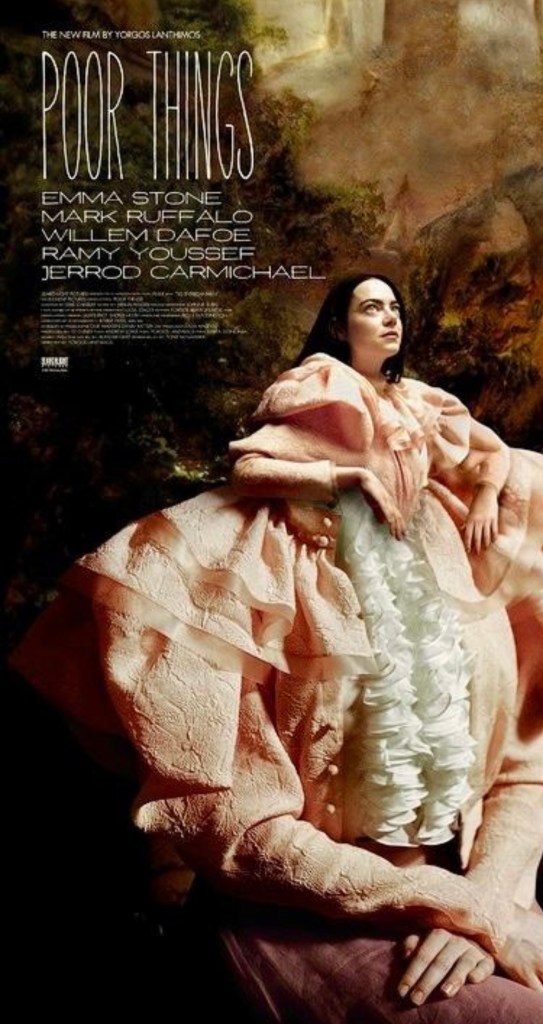
.
Every so often, but still quite rarely, a film will come along in which everyone involved is doing their absolute best work. Oppenheimer, for all its excellence, is not one of these movies (they didn’t give Florence Pugh or Emily Blunt enough to do). Neither is There Will Be Blood, Parasite, Moonlight or even Paddington 2. Gerwig’s Little Women qualifies in my mind (not Barbie), as does Black Swan, Goodfellas, maybe Gravity, When Harry Met Sally, Schindler’s List
and, I think, Poor Things.
Okay, Willem Dafoe has probably been better (see The Florida Project) but he largely seems to have settled on doing quirky character parts recently and this is definitely his best of those. Everyone else though, from Emma Stone to director Yorgos Lanthimos and writer Tony McNamara, to the costume department, the production designer, make up artists, editor and intimacy coordinator, they are all at the absolute top of their game on this one.
This is not a consummate adaptation of a classic book though, or a sophisticated psychological thriller, a great crime epic, some science fiction masterpiece, perfect comedy or moving historical drama, or if it is it is all seven. Poor Things is one of those movies that is typically called, now let me get the right critical term here.. bonkers. The success of films like Everything Everywhere All At Once and The Shape of Water have made this type of work more mainstream of late, and indeed Lanthimos has been slowly building this with his projects too, but this kind of thing has always been an interesting side project for big name artists and stars before, not the pinnacle of their careers.
Take Emma Stone, she got her Oscar for La La Land which was deserved but was a clear step on from what she had done before, you could see the trajectory. Then working with Lanthimos for the first time in The Favourite she took a left turn and here we are. She is and was able to steer back having done Zombieland 2 and Cruella (you suspect one of those might have been a contractual obligation) but this is what she evidently does best; bold, imaginative, surreal, fantastical and surprising cinema. The demands of this part are unlike anything she’d get doing something mainstream and she totally meets them. Part, but by no means all, of this is the nudity which is not mild but is typical of her commitment to this story.
The story in question sees her young woman, Bella Baxter, on a journey to find her place in the world, after the most unorthodox entry into it. I don’t want to say more than that other than to suggest that this is a character who has no preconceived ideas of right or wrong and the choices this leads her to make contrast interestingly with those she would otherwise be expected to, by her society or ours. She is also not inured to certain injustices, setting up notable inconsistencies between what she will accept compared to others. The narrative has much to say about human nature and constructs of femininity.
None of this is really giving you an idea of what to expect from this movie though. You kind of have to see it for yourself and you do kind of have to see it. It heads into the awards season with a number of nominations and wins already from the American Film Institute and, significantly, the Alliance of Women Film Journalists. It’s certainly going to have a few Oscars to reward all the excellent work come March, and while it doesn’t mean much to say this is currently my film of the year, I’m sure it’s going to land close to that in December. To say it is a perfect movie seems to place on it some convention it strives to shirk, so let’s fall back on where we started; everyone here, in every aspect, in every department has achieved exactly what they could have hoped, and it’s all brilliant.
.
The Ripley Factor:
It’s hard to know if this film would have worked as well without the same level of nudity. There is no question it is there in service of the story and like Park Chan-wook’s The Handmaiden, to have been reserved in this one respect would have seemed out of place with the full on nature of everything else. Since this is Emma Stone, at least we can assume she is not being in anyway coerced into stripping off, just as Jennifer Lawrence clearly wasn’t in No Hard Feelings. Established stars like them are quite capable of maintaining a no nudity clause if they wanted to, just as Margot Robbie clearly did in Babylon and clearly didn’t in her breakout role in The Wolf of Wall Street. Also, there is male nudity here too, of equal measure, so it is partially balanced even if there’s no suggestion that the men are being objectified.
Significantly the entire narrative is also about a woman finding her strength and taking control in a highly patriarchal environment. There is no denying that this is a demonstrably feminist film with an ultimately strong female role model. She is most definitely used by men and treated as their property but she has certainly broken away from this by the movie’s weird, slightly dark, but immensely satisfying denouement.
 The Not Left Handed Film Guide
One thought on “Poor Things”