.
A few years ago I was at a BFI conference when someone in the audience asked a black film maker on a panel whether it was okay for them as a white person to explore and write about Afro-American cinema. I thought I knew the answer to this but listened with interest, not only as someone who aims to analyse all key elements of movies myself but specifically as a man who consciously looks at films from a feminist standpoint. The response was not one that was a million miles away from what I’d supposed but it had an angle and succinctness that has stayed with me. ‘It’s important that you are part of the conversation’ they said, ‘as long as you acknowledge that your experience can only give you your own point of view’.
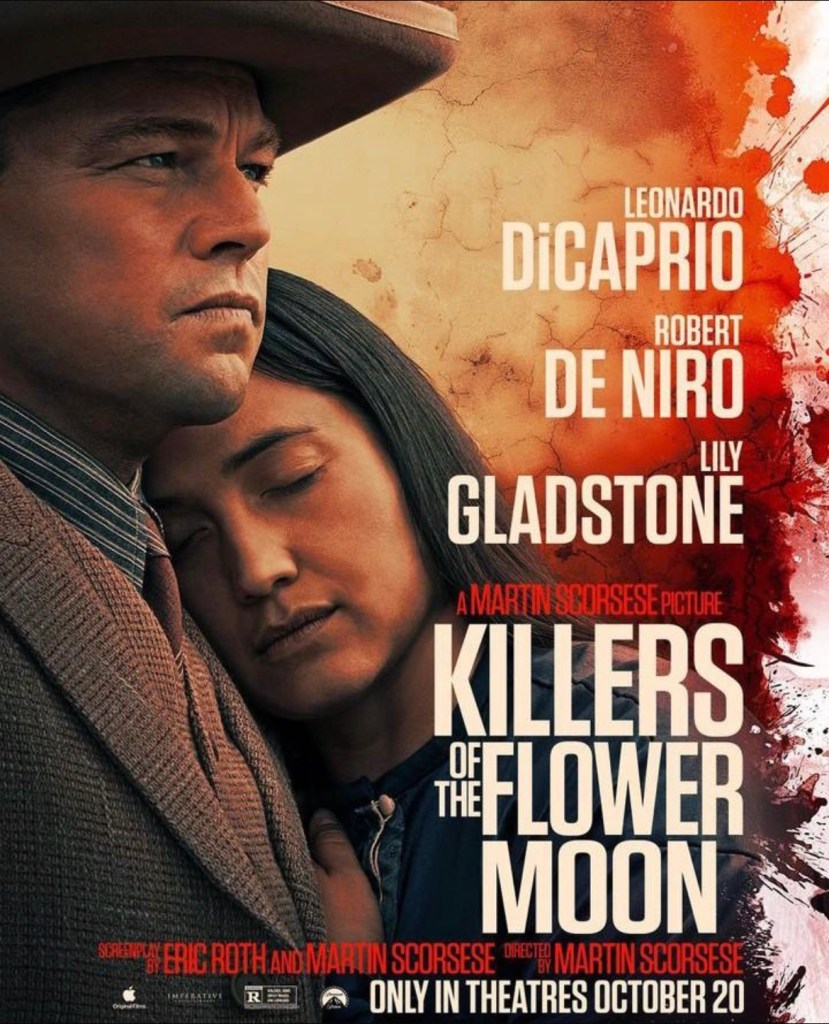
It is interesting to think of this when watching Killers of the Flower Moon; a film about the experience of the Osage Native Americans in post WW1 Oklahoma made by a white director. It is great that Martin Scorsese has brought this true story to a wide audience but it is a very very Martin Scorsese version of events. There is no denying that this is a masterwork of cinematic storytelling that easily sustains its three and a half hour running time. Nonetheless I am sure it could and would have been different (though sadly not as commercially successful) if it had come from another film maker such as Chris Eyre or Sydney Freeland, who are Cheyenne and Navajo respectively.
More than some vague speculation though, it is pretty clear how the content of this movie is as it is with Scorsese at the helm. There a number of angles he could have taken with this movie. The 2017 book by David Grann (who is also white) is actually titled Killers of the Flower Moon: The Osage Murders and the Birth of the FBI and as indicated has a dual focus on the multiple homicides and the impact the subsequent investigation had on the reputation of the fledgling federal agency that brought the perpetrators to justice. This latter aspect was apparently going to be a big part of the film at one point with DiCaprio playing agent Tom White, but they steered away from this with that becoming an element that only features for the last hour or so, with Jesse Plemons as White.
You’d think the alternative would then have been to centre on the people who were the victims, as they were taken out in a series of hits so that the white community could steal the huge wealth they had amassed following the discovery of oil on their ancestral land. This is what I am sure an indigenous director would have built everything around and it is the film I wish this had been. Much has been made of Lily Gladstone who appears here as Mollie Kyle, one of four sisters due to inherit their family’s considerable estate. She is indeed excellent, all wry mistrust at the start and then a fascinating mix of strength and vulnerability at the end. Cara Jade Myers is also excellent as sibling Anna, and William Belleau gives a nicely nuanced performance too. It’s not their movie though and they are all sidelined a little, even Gladstone.
Nope, what Scorsese has done is fall back heavily on what and who he knows. Regular collaborators DiCaprio and DeNiro are the stars here and by telling their characters’ story first and foremost; a tale of a powerful and corrupt patriarch bring his naive nephew into a world of cold crime and manipulation, he has made this a gangster movie. It is absolutely the most Scorsese thing he could have done and captivating as it is, it feels off. He has done things differently recently with Silence, Hugo and Shutter Island, but here he has gone right back to type.
You could argue that what he is doing for his entry into this conversation then is truly acknowledging that his experience can only give him his own point of view, to a fault. Maybe it would have been false of him to try and tell this story any other way but that being the case I’d think I’d have rather someone else told it. In any filmic conversation Martin Scorsese’s voice is always going to be one of the loudest so that’s not just joining the discussion, it’s dominating it.
I can’t fault this as a Scorsese movie, it is a really good one and certainly eclipses The Irishman and Wolf of Wall Street, but there is an good argument that this shouldn’t have been a Scorsese movie at all because it was someone else’s story to tell. He could at least have collaborated with a better positioned writer but instead he has turned to another old white guy, Forrest Gump, Benjamin Button and Dune’s Eric Roth.
.
The Ripley Factor:
The film features a number of strong women but every single one of them is at best manipulated and dominated by men, and all too often destroyed by them. It may not have been historically accurate to have made this a feminist fable, Mollie and her family were prey to the worst kind of racist and chauvinist exploitation and were not able to stand against this alone, but there are things the script could have included to make this more balanced. In reality Mollie made some effort to save herself by communicating her fears about her situation to a local priest but this is not featured here. Rather she is a passive, even willing, victim waiting to be rescued by the US Government. They do have her directly flagging the murders of her people to President Calvin Coolidge but this feels a token plot inclusion in the context of the rest of the film, and is an event that certainly didn’t happen in real life.
The narrative could have made more of her eventual defiance as well but instead she is confusingly enigmatic about the whole thing. Killers of the Flower Moon actually has a slightly clumsy denouement that Scorsese demonstrably manages to make totally about him when I’d have much rather seen a coda all about her.
Hear from more authentic voices here
 The Not Left Handed Film Guide