.
.
Kenneth’s Branagh and screenwriter Michael Green have been trying to do something new with Hercule Poirot since 2017’s Murder on the Orient Express. In their interpretation, also seen in last year’s Death on the Nile, Christie’s famous literary character is not so much a prim gentleman detective as a tortured soul whose fastidiousness is an oppressive cocktail of OCD and PTSD. Furthermore the mostly inconsequential infatuation Poirot held for the Countess Vera Rossakoff on the page, the only evidence that he was anything but completely asexual, has been replaced in this version by a life long melancholy suffered after the loss of his beloved Katherine. This heartbreak is something that seems to utterly define him yet ultimately adds little plot wise. All the while they have been reframing the much portrayeds protagonist though, the stories he is in have not wandered far from those Agatha Christie initially provided.
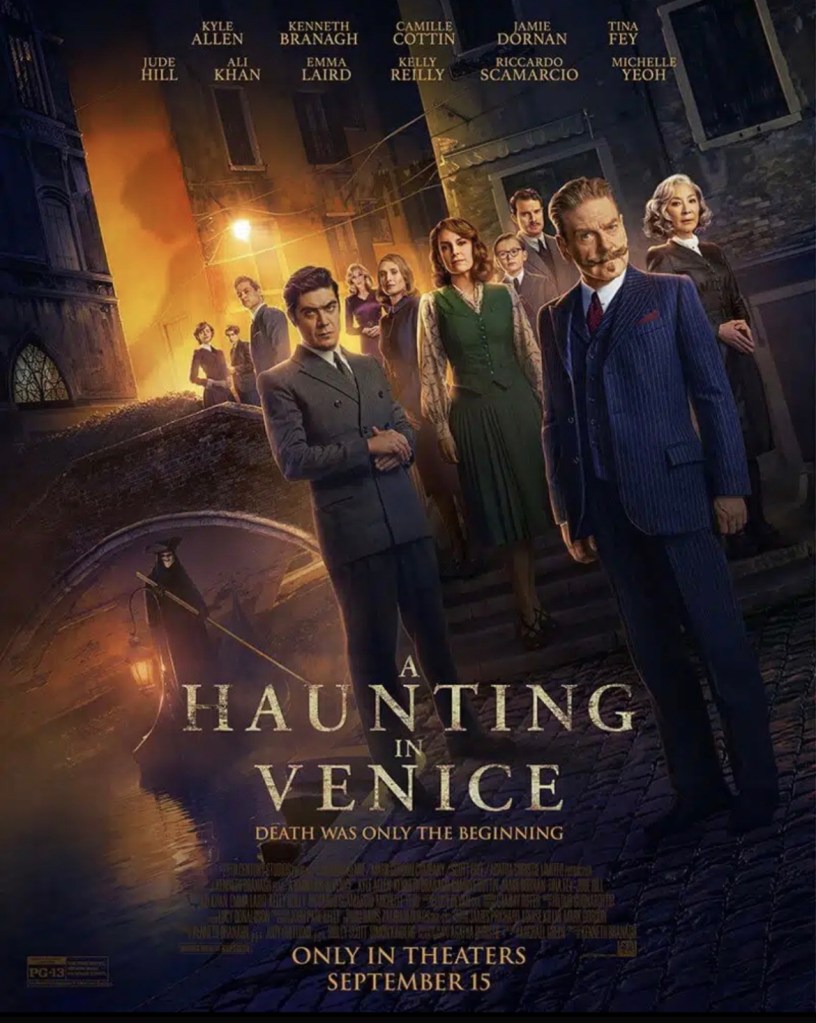
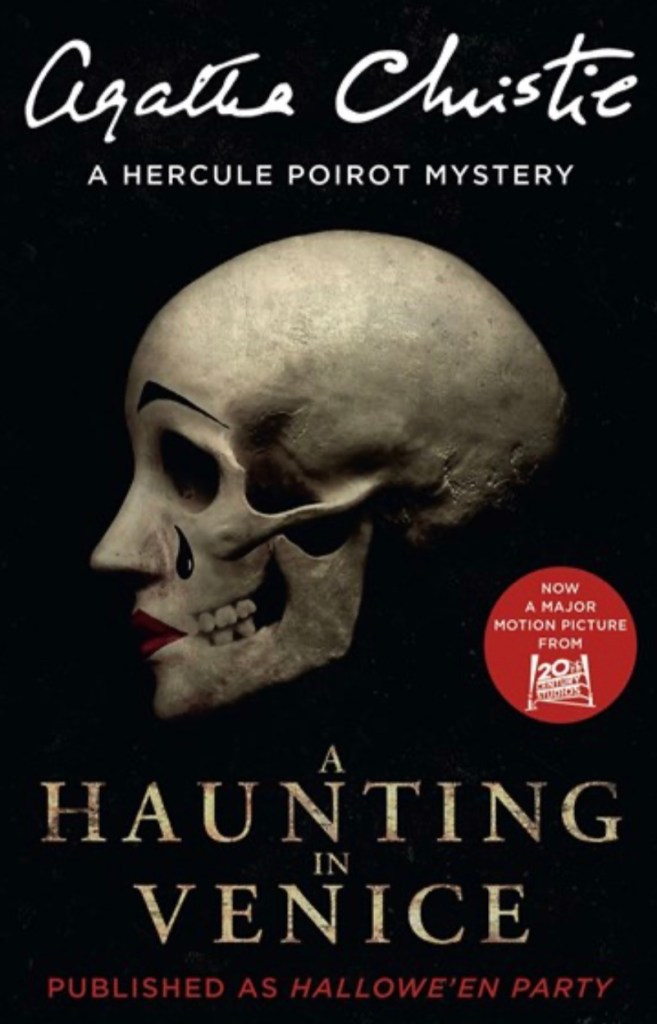
Now, in this third film they have gone a step further in reinventing the idea of the typical Poirot movie (of which there have now been fifteen, as well of course as the seventy episodes of the David Suchet TV show) by writing a completely new adventure for him. A Haunting in Venice is being sold as an adaptation of Christie’s 1969 book Hallowe’en Party but in truth it really isn’t. There are elements of the narrative shared with this novel but no more than there are with her books The Sittaford Mystery or The Pale Horse, or indeed Anthony Horowitz’s 2011 Sherlock Holmes tome The House of Silk. There are even notes of previous films like The Others and The Sixth Sense. It is going to be confusing for people that read the movie tie in version of A Haunting in Venice for sure, when they discover that there is no haunting and it’s not set in Venice. No, to some intents and all purposes Branagh and Green have taken their Poirot and this time placed him in a story effectively of their own creation. What’s more it has very heavy gothic horror leanings which only further sets it apart from the world this man has existed in before.
.
.
For all of this though, A Haunting in Venice feels the most Poirot of all of the three movies Branagh and Green have done. The errant characterisation they have given the Belgian sleuth before is dialled down here in favour of the added supernatural elements. These alternate genre additions are not ultimately that strong though, they are certainly not that scary, so what we are left with is a smartly complex murder mystery with buttoned up people in a run down Italian palazzo.
None of it feels too far away from the Sunday teatime TV dramas where many people will be used to seeing this character so with their latest attempt to do something different they have ended up produced something that feels quite familiar. For me though, this is not a bad thing. A Haunting in Venice may not be groundbreaking but it is perfectly entertaining.
Personally I didn’t object to the direction they have taken with Poirot in these movies but I also never felt it quite landed. It was almost trying too hard and it became a bit of a distraction. (The 2018 small screen adaption of the ABC Murders with John Malkovich managed the edgier tone better probably because he was less mannered.) Here though Branagh seems more settled in the role and finally the story is allowed to be about the crime at least as much as it is him. There is less showboating from the other actors too. It was a tradition started by the Albert Finney Murder on the Orient Express in 1974 that all Agatha Christie movies had to have a starry cast and A Haunting in Venice’s two predecessors certainly leant into this. This film seems more concerned with getting the right names rather than the biggest ones though and is better for it. Some of the more irritating aspects of Death on the Nile are also absent. There is strong symbolism with water in this one but nothing as corny as the portentous shots we had of crocodiles picking off weaker prey on the river bank from last time. The dodgy CGI shots of Egypt have been replaced by some beautiful aerial views of Venice too. There is heavy use of fish eye lenses that may irk some, but I liked that.
There are still things to object to here if you chose; for example the purists are not going to like what they’ve done with established Christie character Ariadne Oliver (I know this because I live with one). As played by Tina Fey she is a mix between Agatha Christie herself and Hedda Hopper which is definitely not how she was written. Generally though this is a neat film with tight plotting and an effective ensemble cast. Thirteen year old Jude Hill is working with the director again after his great performance in Belfast, again playing Jamie Dornan’s son. Michelle Yeoh gives a very different performance to that we have seen from her before and it is nice to see Kyle Allen land a high profile role after his great turn in The Map of Tiny Perfect Things a couple of years ago.
.
The Ripley Factor:
One of the things all three of these films have been good at is presenting Christie’s female characters with all of the traits but none of the tropes. All of the women here are rounded and flawed as people are and each is harbouring some level of deceit. The weakest and most manipulated players here are actually men. Fey’s Ariadne Oliver has a particular new agency which is part of what the die hard fans may object to because it totally rewrites her motivations but she is certainly more than the two bit Marple she might have been before so that is arguably a step forward.
 The Not Left Handed Film Guide