.
The French Dispatch, director Wes Anderson’s last film was widely praised but I found it borderline insufferable. I just thought the quirks that Anderson is known for putting in his movies were cranked up so high in that one that it almost parodied itself and if that were the case, it wasn’t an affectionate take down. It became tedious. Similar criticisms are now being widely levelled at Asteroid City, This, they are saying is only one for the die hard Anderson fans. I might have described myself as an Anderson fan too before I saw The French Dispatch. I went in here with some trepidation then.
Well maybe I am still a devotee after all because I really enjoyed this one. It isn’t as good as the best of his previous work; Moonrise Kingdom or The Grand Budapest Hotel, (at which statement the real die hard fans scream Royal Tenenbaums at the top of their voices) but it does have quite a lot of charm and even moments of some sweetness. It is a lot more reserved than The French Dispatch which just felt relentless in its attempt to present idiosyncratic people doing unpredictable things, with affectation strewn scripting and overly stylised set design. In fact it is a lot more reserved than much of Anderson’s filmography and is much the better for it.
When Anderson took his first full foray into full animation with his adaptation of Roald Dahl’s classic of children’s fiction Fantastic Mr. Fox, there was some discussion after around how it was exactly what you’d expect of this particular filmmaker’s take on a kid’s movie. Well, Asteroid City is absolutely Wes Anderson does sci-fi.
The main location is the titular desert burgh characterised by its huge meteor crater, following a strike some thousands of years earlier. This being the case it is a site of astronomical interest that hosts an annual youth stargazers convention and on this occasion the attendees are treated with some exceptionally rare sights indeed. This part of the narrative is actually a play within a play so we also see the fictional actors and artists backstage as they present this story but this aspect is a lot less interesting and actually forms a bit of a distraction. It is the portrayed events in the isolated district of Western America and the made up visitors it attracts that carry the appeal and interest.
As you would expect from Anderson working in this genre, there is a lot of retro futurism with ball ended ray guns and chrome rocket packs, but his mark is also seen in the nature of the government officials and the knee jerk interventions that result from what goes on. People’s dry, unpanicked reactions to the circumstances they find themselves in is also very typical of the director. I am deliberately avoiding specifics of what occurs for fear of spoilers but if you notice who Jeff Goldblum is listed as playing in the opening credits you’ll get some detail here anyway.
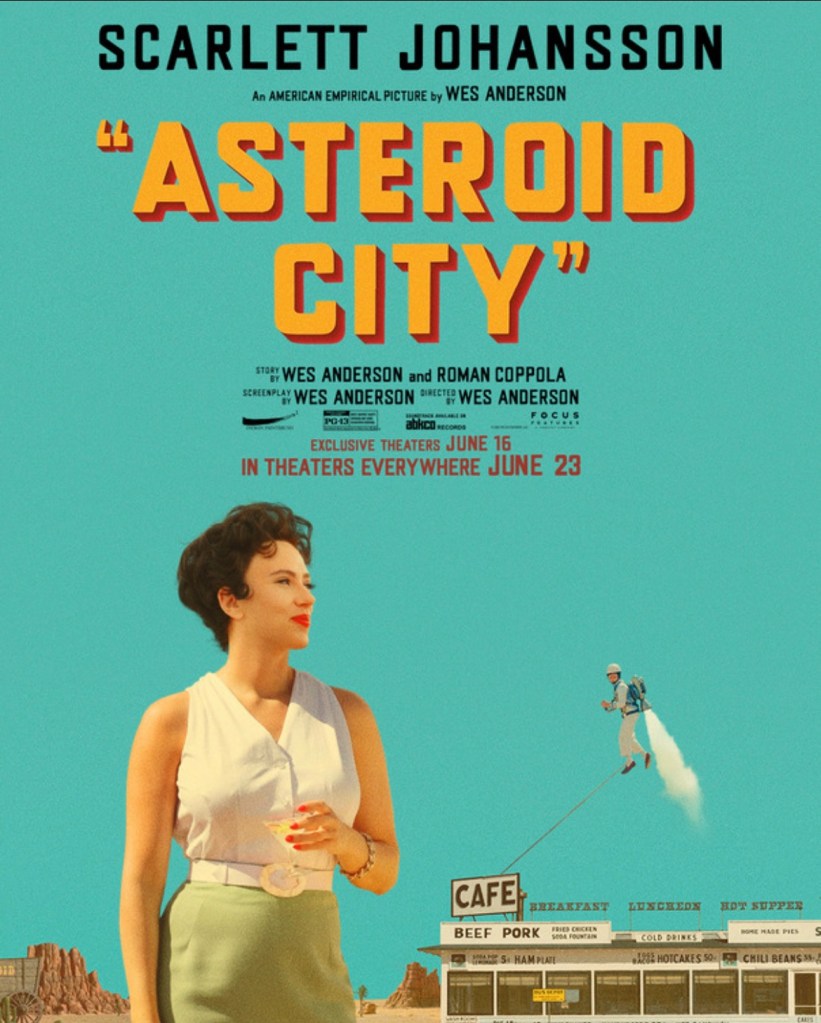
The other thing you expect from any new Anderson project is a huge starry cast, many of whom are utterly wasted. That is the case here, on both counts, but some of the performances are a delight. Steve Carrell is a highlight but the movie probably belongs to Scarlett Johansson who makes her first appearance for this director (she did a voice in Isle of Dogs). Her Midge Cambell/Mercedes Ford is enigmatic yet magnetic and she suits this style of filmmaking well. There are others like Tom Hanks and Maya Hawke who don’t fit into the Anderson mould as comfortably, but Johansson is a perfect fit. Rupert Friend totally got the brief as well.
When discussing the film with the friend I saw it with, she observed that it had some really nice moments in it (hi buddy, happy birthday again). Actually that is essentially all it is, just a series of nice moments, but they are engaging and entertaining so so is the movie as a whole. Those moments mostly revolve around dialogue and characterisation (minimal characterisation, as ever with this guy) but they work. The typical Anderson monologues I could do without but you’ve got to take the good with the bad and the here, unlike with The French Dispatch, the former outweighs the latter.
.
The Ripley Factor:
Wes Anderson has written good female parts before, mostly for Tilda Swinton, and the same is true with this. There is one brief moment when Johansson is shot naked, although I’d not have been sure it was her if she hadn’t said so in interviews. There is even a line about using a body double that I thought was confirming they had done that here but apparently not. I don’t think the moment is particularly necessary but who ever truly knows Anderson’s artistic choices. Either way the camera doesn’t linger and it is not particularly sexy.
Among the characters that stand out are also three young girls played by triplets Ella, Willen and Gracie Faris who are smart and headstrong and also really formidable, particularly when you consider that they are only six.
 The Not Left Handed Film Guide