.
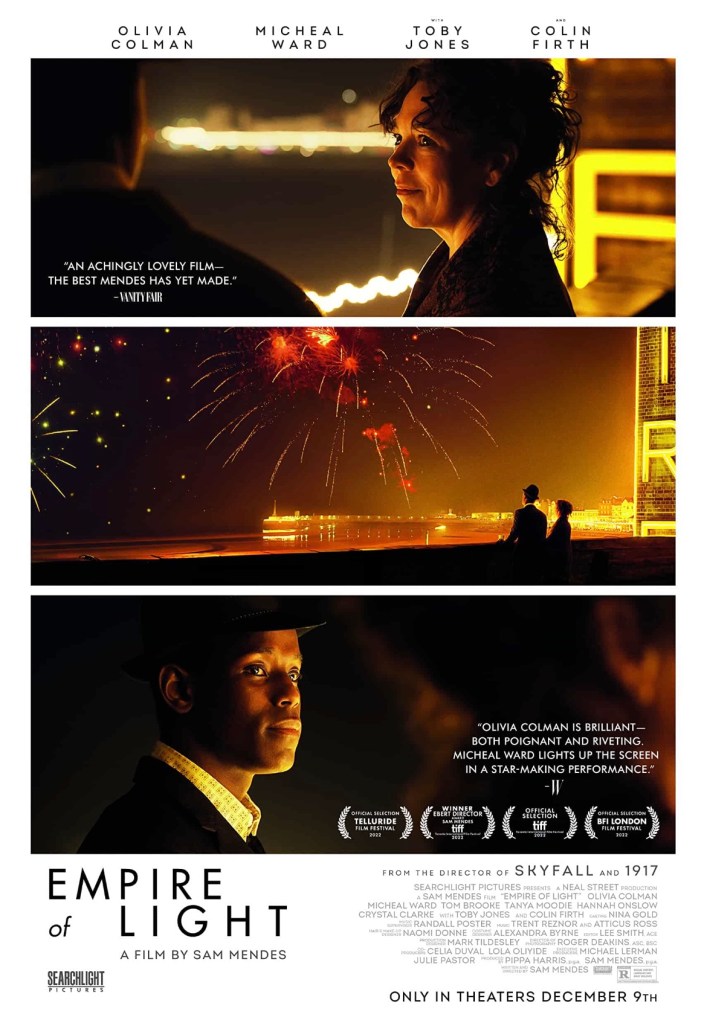
It is hard to know decisively what the title of this film refers to. The obvious suggestion is that it’s the cinema that much of the story is set in; known as The Empire and situated on an unnamed seafront somewhere in the South of England. (It is actually The Dreamland in Margate, read about the building here.)
Despite being almost constantly onscreen though, the location is almost incidental – at least compared to what you’d expect for a movie where a film house is so heavily featured. This is most certainly not a new Cinema Paradiso. It doesn’t even manage to celebrate the joy of movie going and grand cinema palaces as much as last year’s Save the Cinema whose titular location was actually more of a theatre. I can name you ten other films that celebrate cinema more than this one without even thinking about it.
1. The Artist
2. Belfast
3. Who Framed Roger Rabbit
4. The Purple Rose of Cairo
5. The Last Action Hero
6. Matinee
7. The Shape of Water
8. True Romance
9. The Last Projectionist
10. 1941
There you go. You can tell that was off the top of my head; if I’d thought about it I’d certainly have mentioned The Smallest Show on Earth and Sherlock Jr.
There is a brief speech from Toby Jones’ projectionist, and a single extended scene of one person watching an old Peter Sellers film that captures some of the magic but otherwise this tends to show going to the movies as a pretty mundane experience and certainly not something you’d do if you had an otherwise fulfilling life. The building is magnificent, no question of that, even the derelict rooms upstairs, but to be honest for most of the running time this might as well be set in a supermarket or a pizza place.
It is possible, on the other hand, that the Empire we are talking about here is the British one. The film certainly presents a snap shot of the UK at a certain time in its history but there isn’t a lot of light in this. This is not a nostalgic look at a better time, this is the early 1980s and yes you could get a box of Malteasers for 20p but you could also get inadequate mental health care or if you were black you could also get abused and beaten up. There is arguably very little optimism being offered here, not by the state of the country and not by the inside of the local three screener.
Essentially the question around the name can be summed up by saying that this movie doesn’t quite seem to know what it is, and it certainly isn’t what it is promising. At its heart Empire of Light is a portrayal of a woman with major emotional wellbeing issues and everything else is just set dressing. The way this central theme is explored is strong but all the narrative aspects around it, geographical and historical surroundings included, are not as well developed.
Director Sam Mendes’ whole film career has been a mix of big action and high drama with some of his projects featuring one of these (Spectre, Revolutionary Road, Away We Go, American Beauty) and others blending both (Skyfall, Jarhead, Road to Perdition, 1917). This one is definitely the former with the story centring around one person with the only explosions being of temperament. There are significant characters in protagonist Hilary’s orbit but they all feel more like filmic constructions than her, especially Michael Ward’s Stephen. Colin Firth appears in a supporting role that seems to be deliberately chosen to play with and fracture his usual debonair image and again, he is only there to be a part of someone else’s story.
There remains though, that central performance. 1917 was apparently written for Mendes’ grandfather who had fought in the Great War and this one is for his mother who had her own internal battles much like Hilary. With this personal knowledge the depictions of depression and paranoia are sensitive and realistic and Olivia Colman is typically brilliant in the role.
Ultimately it is hard not to think this film couldn’t have been better. It does hang on a really strong piece of characterisation but in this case it isn’t quite enough. The efforts to bring in the politics of the time and the fumbled sense of romance around notions of going to the cinema don’t fit and any moments of dramatic tension just come across as awkwardness. This was my first trip to the movies this year and I’m afraid that this one didn’t quite take me to the cinema in the way I’d hoped.
.
The Ripley Factor:
While I wanted some of the other people in the film to be better written, there is something refreshing in having male characters who only really exist as part of a woman’s story because it is so often the other way around.
Also, mental health has too often been presented as a female issue, both historically and in film and literature, and this avoids the traps that other things have not. The word hysteria, which in its traditional definition relates to neurological or emotional maladies, has a very gender specific derivation, and is good to see a film that steers away from connection. Most of the well known movies of the last few decades that feature women in this context, things life Girl, Interrupted, Black Swan, Unsane and Tully don’t avoid this completely but Empire of Light does.
.

.
 The Not Left Handed Film Guide