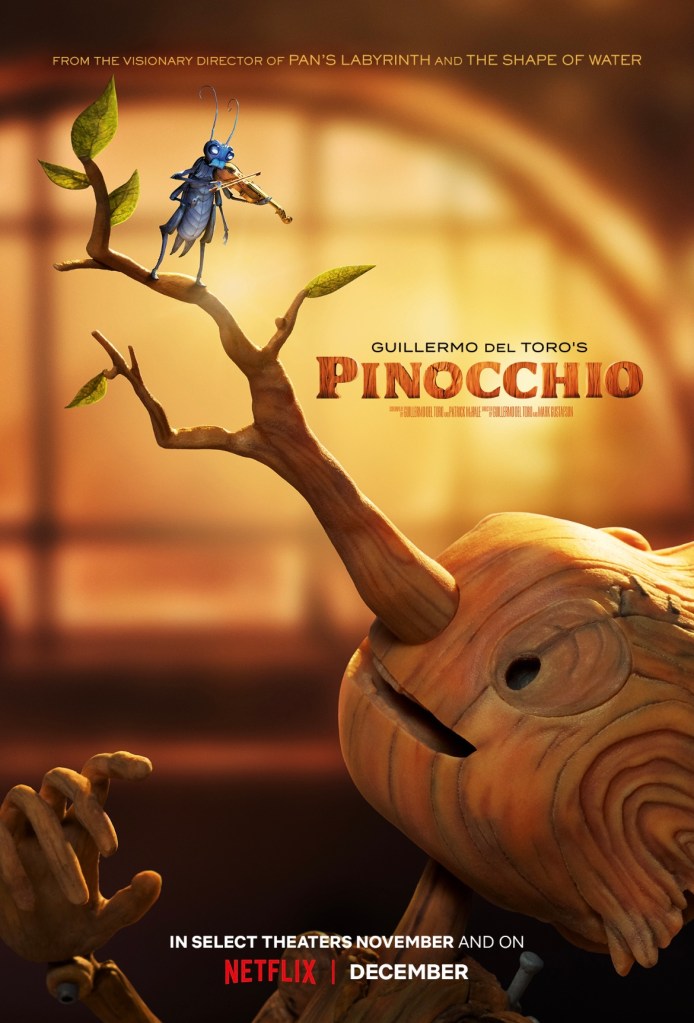
.
In Carlo Collodi’s original Pinocchio book when the famous puppet first meets Jiminy Cricket and the insect tells him what to do, he immediately kills him with a hammer. Sweet old Gepetto is also imprisoned for suspected child abuse and at one point Pinocchio falls asleep too close to the fire and his feet get burnt off. This isn’t some old folk tale from some darker time either, like the original version of Cinderella where the ugly sisters cut chunks off own own feet to get them in the slipper; this is a children’s novel from the late 1800s. This is only a little after Carroll wrote Alice Through the Looking Glass and around the same time Stephenson and Kipling gave us Treasure Island and The Jungle Book. I know those tomes had their own strong elements but this is a text that soon after it was first translated into English would have been on the shelves next to The Railway Children and The Wind in the Willows. We’ve lost sight of it now but this was quite a twisted story when it first came out.
Of course, it wouldn’t have been Jiminy Cricket back then. This was a name given to the famous insect character by the classic Disney film which is obviously the same version that shaved a lot, if not quite all, of those sharp edges off. Sure, there have been many other movie adaptations of the source material but it is this one that has the greatest influence over what people think of when they hear the name Pinocchio, as was only compounded only this year when the company put out the inevitable live action version of their famous cartoon.
Well now Guillermo del Toro has had a go and, as you might imagine, the darkness is back.
This is definitely not Disney’s Pinocchio. I mean it literally says whose it is in the title but even more than films like Mary Shelley’s Frankenstein, William Shakespeare’s Romeo + Juliet and last month’s Roald Dahl’s Matilda the Musical, having the creator’s name on the billboard is a statement of intent. Of course in those examples the checked people are all the original writers but this is not Carlo Collodi’s Pinocchio either; del Toro is definitely the creative force behind this and the movie brings all of that man’s fascination with fairytales, mortality, national conflict, childhood corruption and subterranean winged creatures. It also has his incredible production design and huge heart.
This isn’t to say that the director has not been influenced by others. A few of those events from Collodi’s book I talked about do find representation in some ways and the moment of Pinocchio’s birth, fuelled by rampant grief and out of control mania coupled with obsession and followed by repugnance, definitely has echoes of Shelley’s aforementioned gothic horror masterpiece. There is a line at the start as well, about old spirits living in the forest who rarely involve themselves in the human world, but occasionally do, that I am sure is from My Neighbor Totoro. The stop motion animation brings comparison to other films too but not Aardman or even Tim Burton, think instead of this being positioned between Kubo & the Two Strings and Isle of Dogs, both in terms of style and quality.
Don’t be put off by the fact that I’ve just told you this is not as good as the best of Studio Laika’s work. Kubo and Coraline present very high bars and this is in that league. For me, Guillermo del Toro’s Pinocchio took a while to settle in (or I took a while to settle into it) but by the halfway mark I was hooked and after one key event around half way through (the surprising death of a main character as it happens) the story goes to some fascinating, moving and, yes dark, places.
Collodi dark and del Toro dark are evidently very different though. For one it was about squishing talking bugs, mischievously letting your father figure get locked up, and as you will no doubt already know, turning into donkeys and getting swallowed by giant sea creatures. For the other though it is about slavery, war and murder. The mutant whale does turn up in this version but del Toro is less interested in fabricated fish and more in factual fascism. Moving things forward almost sixty years from when the story first came out but keeping the Italian setting, the plot here unfolds under the reign of Mussolini. The big man even features in one very amusing and very surreal scene that, due to its scatological content would particularly appeal to the under fives were it not for all the politically sanctioned murders that follow. No, for del Toro it is never darkness for darkness sake. There is an honesty to the examination of evil here that escapes many other traditional storytellers.
For all its more grown up content though the movie manages to stay on the right side of family friendly, presenting a story that deals with adult themes is a way that is totally appropriate for children. The movie is rated PG and finds the right balance of charm and harm as all the best fables do.
The other version of this story that Robert Zemeckis just directed for Disney+ was already pretty forgettable but this movie wipes it clean from the memory. There is one method of escape later in the narrative that they oddly share, an unfortunate coincidence for both sets of film makers I am sure, but generally this makes mention of the other utterly redundant.
Whereas the famous 1940 cartoon and its recent remake rewrite the original tale then, del Toro and his co-director animator Mark Gustafson have reinvented it. If you only watch one Pinocchio this year it has to be this one, and in fact if you are only going to go for one version ever then it might be this one too. This film is superb.
.
The Ripley Factor:
There is only one main female character in the original Pinocchio, namely the Blue-haired Fairy (the azure colour having been commonly extended to the whole of her thanks again to Mr. Disney). She is one of very few women in this version too but here she is joined by a sister. These two sprites are the benevolent guides for the little wooden boy though and as such are the wisest and most sage players in the whole piece. I’m not sure I’d call either of them women though.
 The Not Left Handed Film Guide