.
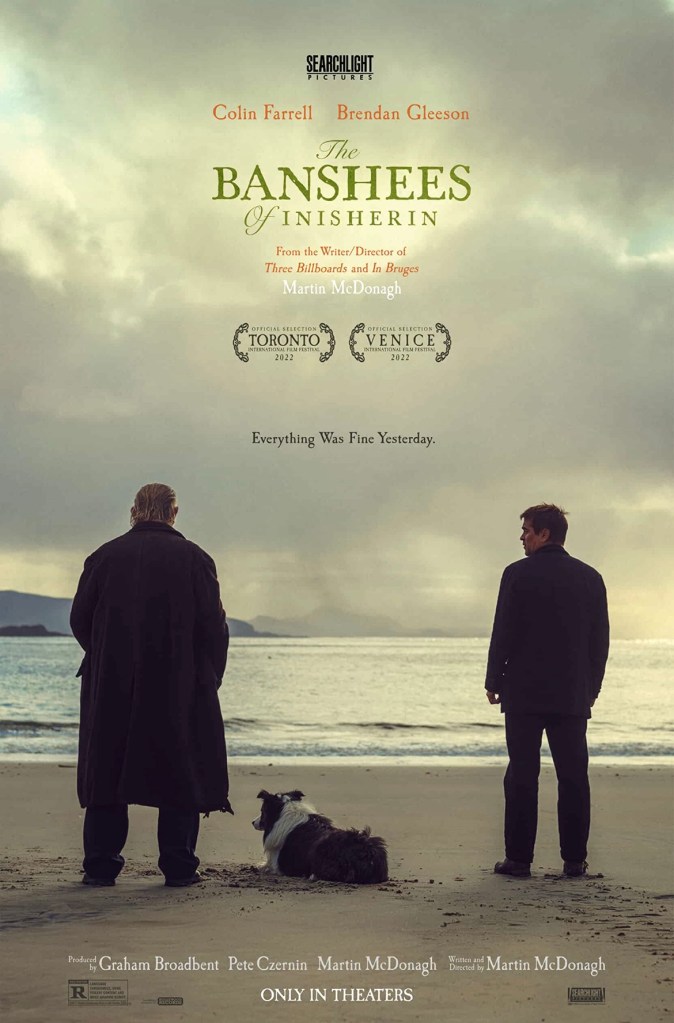
It feels overly simple to discuss The Banshees of Inisherin as a metaphor for the Irish conflicts but it is all there, laid quite heavily over the narrative.
The story is set on a fictional Irish island in 1923, where they can look across the water and see the explosions and hear the gunshots of the Civil War on the mainland. In the shadow of this two men who have been friends for years, and still should be, fall out for reasons they ought to be able to overcome and soon stubbornness, pride and anger escalate the situation. They become vicious and self destructive, the most innocent parties get caught up in it, dubious and unstable alliances are made and they lose sight of the morality of what they do. By the close of the movie it is clear that while this conflict may have met it’s apex, it will never truly end. Inisherin apparently even translates to ‘Island of Ireland’. It’s neat but it almost all seems too obvious.
Maybe this is the point though. If you look at the tradition of folk tales, that this could easily fit into, then they are often uncomplicated in the storytelling and their approach to any lessons imparted. If read as some kind of fable all of the unsubtleties of the film are just part of the medium. Taken like this there are other extreme actions on the part of some characters that don’t need challenging so much. Witches, ogres and various other mythical creatures are forever eating people, casting curses and mutilating bodies in those kinds of stories so what happens here perhaps seems less odd by comparison. There is already a suggestion of dark paganistic magic here as well, even outside of the mention of banshees. Viewed in this way the film is lyrical rather than unrealistic and the similes sit more comfortably.
None of this is to say that the acting is stylised. Whether you factor in all of the above or not, what this also is is a heartrending break up story and the pain and anger felt by Colin Farrell’s Pádraic is real and relatable. He and Brendan Gleason are both quietly incendiary in the way they play these two men and their broken bromance. They are surrounded by a collection of staunch supporting players too, some leaning toward caricature more than others. Barry Keoghan has been great in a series of films since his breakout performance in 2017’s Dunkirk but still manages to be a bit of a revelation here and Kerry Condon is brilliant as Pádraic’s sister Siobhan.
Much has been made in the press about how this brings Farrell and Gleason back together with their In Bruges director Martin McDonagh and while I don’t think The Banshee’s of Inisherin is quite as good as that film, it does benefit from a greater sense of intimacy. I certainly liked this more than McDonagh’s Three Billboards Outside Ebbing, Missouri where the balance between the dark and the humour was off and it sits well alongside, if a little behind, the director’s brother John Michael McDonagh’s superb Calvary. That film also examined parts of the Irish consciousness but without a sensibility that needs the rationalisation, like this movie.
Whether this film needs to be viewed as discussed or can be taken more at face value, it is a masterful piece of work. It isn’t always an easy watch but it is a rewarding one and the intellectual involvement I have had with it has been welcome. Allegory or treatise, cautionary tale or social drama, it is definitely one you should pull your finger out and see.
.
The Ripley Factor:
This is a movie that critiques distinctly male behaviours so there is something anti-patriarchy in that. In terms of the representations of women though, while there may be a couple of gender stereotypes; the gossip, the crone, this is effectively counteracted by Siobhan who is the lone voice of sanity in the whole thing.
 The Not Left Handed Film Guide