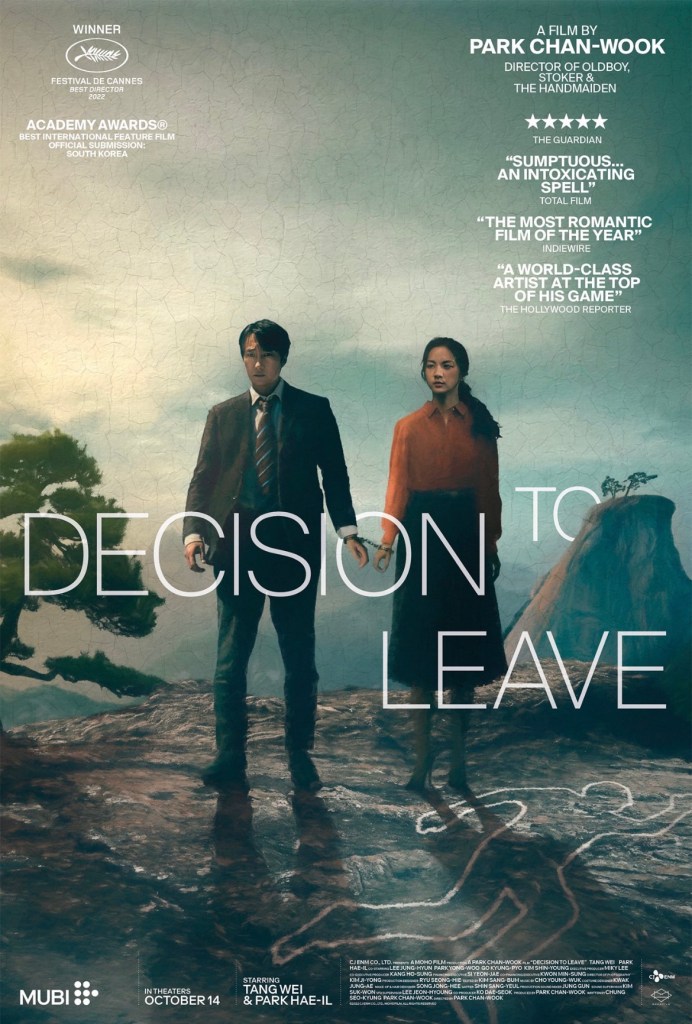
.
There was no decision to go to this film; Park Chan Wook is one of my favourite directors and his last two features landed at number two in my films of the year lists in 2013 and 2017 respectively. (Stoker lost out to Gravity and The Handmaiden was just pipped by Dunkirk.) His TV adaptation of John le Carré’s The Little Drummer Girl was also excellent and if you’ve not seen his 2003 movie Oldboy then you need to rectify that as soon as you possibly can (unless you are under 18, in which case steer clear for a while).
One of the posters for this includes a quote from Variety that says ‘After Parasite and Squid Game your new, sublimely accomplished Korean obsession is here’ and while I can see why they are using that in the marketing, for anyone that already knows Park this is a little like saying ‘Hey, did you enjoy Child’s Play and the Scream movies? Try this guy called Hitchcock.’
As it happens this is not the first time I have referenced the old ‘master of suspense’ in a discussion of one of Park Chan Wook’s films. Writing about Stoker almost a decade ago, having just been properly introduced to his work for the first time, I basically proclaimed Park a modern Hitchcock. I’m not sure if these comparisons were on his mind back then but they certainly are now (perhaps because he read my review) because Decision to Leave is demonstrably his take on Vertigo.
That is not to suggest that this is in any way a remake. You get a strong sense of the classic James Stewart/Kim Novak movie but this is most certainly its own thing. Both involve murders and have a police officer becoming obsessed with a mysterious woman he meets in association with his investigation of this, and there are times when this woman comes in an out of his life, but beyond that what links the films is a feeling of a shared tone.
Park has had to reign in some of his typical sensibilities to achieve this and again I am sure this is in deliberate reference to Hitchcock’s style (and his need to comply with the Hays Code – I think we all know if Hitchcock were making films today he’d make Tarantino look like Walt Disney). While Park’s usual levels of violence are largely absent though this is still rated a 15. If you look at the parental guidance for this on IMDb it says Sex and Nudity: Mild, Violence and Gore: Moderate, Profanity: Moderate, Alcohol, Drugs and Smoking: Mild, Frightening and Intense Scenes: Moderate, yet the film somehow defies these measures and manages to be a full on viewing experience anyway. It is decidedly still a Park movie, it has the same narrative consideration, the same artistry, the same delicate respect for character and the same mastery of the frame, and it is how intense it is that pushes up the certification. (That and maybe a couple of quick cadaver shots). There may not be a lot of skin on show but the sexual tension here is as palpable as I have seen it in any film, including female lead Tang Wei’s own Lust, Caution.
Tang Wei is superb in this film. There is so much in her performance and when they consider this for Best Picture I hope they look at her for her own award. Her character Song Seo-rae is warm yet coldly calculating and strong while being brittle and somehow all of these things coexist without contrast. There are subtleties in how she plays this woman and despite the moral question over her motivations, and yes her decisions, you never stop rooting for her.
In respect of the title, it could apply to a number of moments in the plot; people choose to exit certain situations on various occasions and it is even spoken in the dialogue at one point. I actually think it refers to the end of the movie though when one character makes a particularly shocking decision to remove themselves from a situation when you’d have thought they’d go another way. The plot is a little free ranging and might even slow down at times but it is all brilliantly handled. Midway through the story has come to the pinnacle at which other films would end but then it still has another hour to go. (The Handmaiden did this as well.) The whole thing work towards this denouement though and here you see how every second plays into this. I clearly don’t want to say much about the end but the way the final decision to leave actually ensures that person never will is strangely beautiful. Their actions mean things will forever be unresolved and when you’ve seen the film you’ll know the significance of that.
Decision to Leave is Park Chan Wook doing something different but still working at the top of his game. The film is gripping, sweet and often laugh out load funny. I’ve not mentioned Park Hea-il who plays the detective and he and every member of the cast are strong. There are some great camera angles along with elements of fantasy that reflect the way Cumberbatch’s Sherlock perceived/approached his sleuthing but still feel original. The film may not be as good as the director’s best work but (he quickly looks at it in relation to all the other movies he’s seen this year) number four isn’t a bad position either.
.
The Ripley Factor:
Park Chan Wook has always had significant female characters in his films but several present strong ones and this is definitely a trend in everything he has done in the last decade. The Handmaiden was a clear feminist story, showing women battling against patriarchal convention and in its own way Decision to Leave does the same thing. Whatever Song Seo-rae does, it is on her own terms.
It is significant that this also avoids any charges of female objectification. This is something that is not true of The Handmaiden or Stoker and, despite the high cut below knee dresses, it isn’t true of Hitchcock’s work either. Decision to Leave shows how a woman can be the object of obsession for one of the male characters without being so for the director and the audience.

 The Not Left Handed Film Guide