
.
I wasn’t initially sure what the world needed from a new Marilyn Monroe biopic; certainly not another cheesy TV movie as there are a number of those already. It has to be said that in some respects I’m not entirely sure that’s not what we’ve got but there is more to this that I feel some of the film’s critics have failed to pick up on.
There is some over egged melodrama here then but I’m not sure this is totally the fault of the people involved in this new Netflix movie. This is undeniably a more ambitious and stylised film than much of the company’s traditional material and it comes from director Andrew Dominik who previously gave us Killing Them Softly and the superb The Assassination of Jesse James by the Coward Robert Ford. The film is in some cinemas as well and that is where it comfortably belongs; it is one of Netflix more prestige pics.
The fact is that Marilyn had a tough life, sure there were some ups but the lady ended her own life, probably on purpose, when she was just 36 and Blonde has the reasons for this as it’s main focus. If this is what you are going to concentrate on then a little bit of melodrama is inevitable. Some audiences have objected to the lack of any focus on Marilyn’s successes and achievements and the film could certainly have afforded to bring this to the fore a little more. I am sure her incredible career was not entirely based on the way she looked and she deserves credit for this, but that is not what this is aiming to do. What it wants to highlight is how Hollywood took this woman, chewed her up and spat her out. This mistreatment is a phenomenon that is not as far in Tinseltown’s past as it should be, in fact look at how quickly popular opinion has turned on people like Olivia Wilde and Meghan Markle even now. Women are not treated the same as men in the public eye or behind the scenes and it needs to be discussed. This film raises these points and it does so very powerfully.
What the movie also wants to be is ‘daring, unapologetic and feminist’, it specifically says this on the Netflix access pages. There is no denying the first two of these but the last one is a little shakier. It certainly screams back at the abuse of women and demonises toxic masculinity but it never portrays its protagonist as anything other than a victim and this does feel like another manipulation. This is one of those movies that I would have loved to have seen made by a female director because I am sure it would have been very different and, with respect to Dominik, better. This is telling a woman’s story but it doesn’t have that sensibility.
Interestingly what the film makes no pretences to be is true. This is openly a fictional account of Monroe’s life. This isn’t because Dominik, or Joyce Carol Oates who wrote the original book, couldn’t be bothered to do the research but it does steal it of a modicum of its strength. I have to say though, while it may not be factual, occasional fantasy sequences aside, it is never unbelievable.
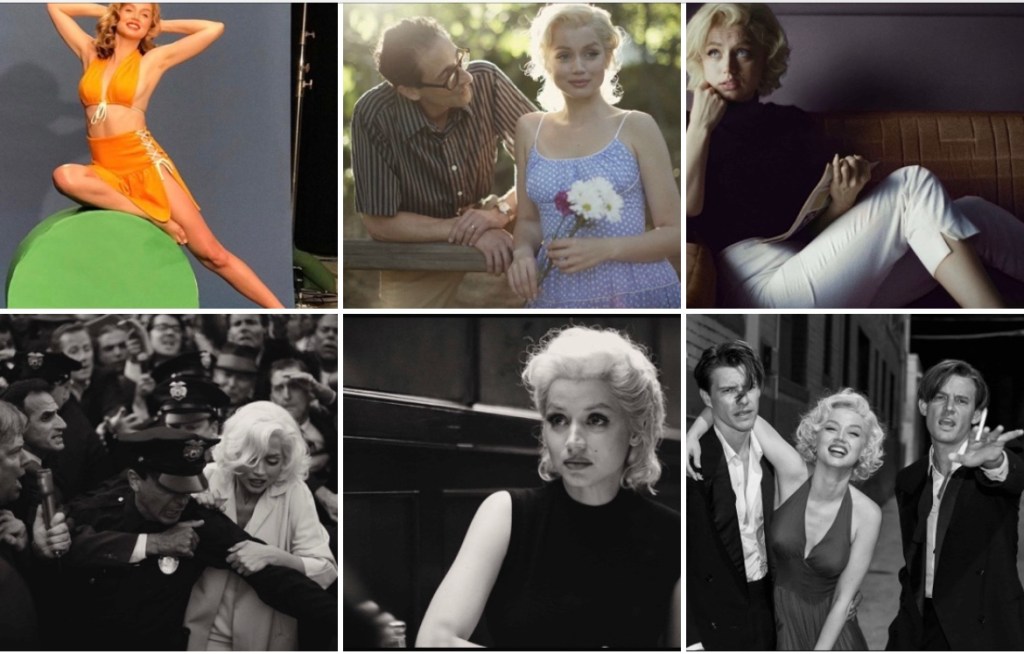
Dominik also uses some wonderful imagery and stylistic choices and the framing is beautiful. The very last shot is simple in its construction but so effective and the director holds on it perfectly. The recreations of Monroe’s films with Ana de Armes seamlessly inserted are also superb. There aren’t any other thirty something actors who can say that have appeared on screen alongside Tony Curtis or George Sanders but she apparently can. The movie also switches between black and white and colour but there does not seem to be any pattern to this. I thought it might be changing between truth and reality or even between when she is performing or when she is being herself, between public and private, but none of these seem to be sustained. These decisions and those with the time jumps are no doubt calculated but they seem random which is frustrating. The laying on of Marilyn Monroe/ Norma Jeane’s daddy issues is also a little strong.
Ana de Armas is brilliant throughout though. Her recreation of both the woman and the icon is spectacular and credit has to go to her and Andrew Dominik for how they have worked on this together. At no point is it ever unclear who she is playing; you could look at any still from this film and have no doubt who you are looking at. Ana de Armas makes her wonderfully flesh though. (Perhaps too much flesh on occasion, the nudity is not salacious but neither is it always necessary.)
Blonde is not an easy watch and actually it makes a lot of Monroe’s real film’s uncomfortable viewing too; I’m never going to see Some Like it Hot in the same way again, but that’s the point and in the end it is a valuable one.
.
 The Not Left Handed Film Guide