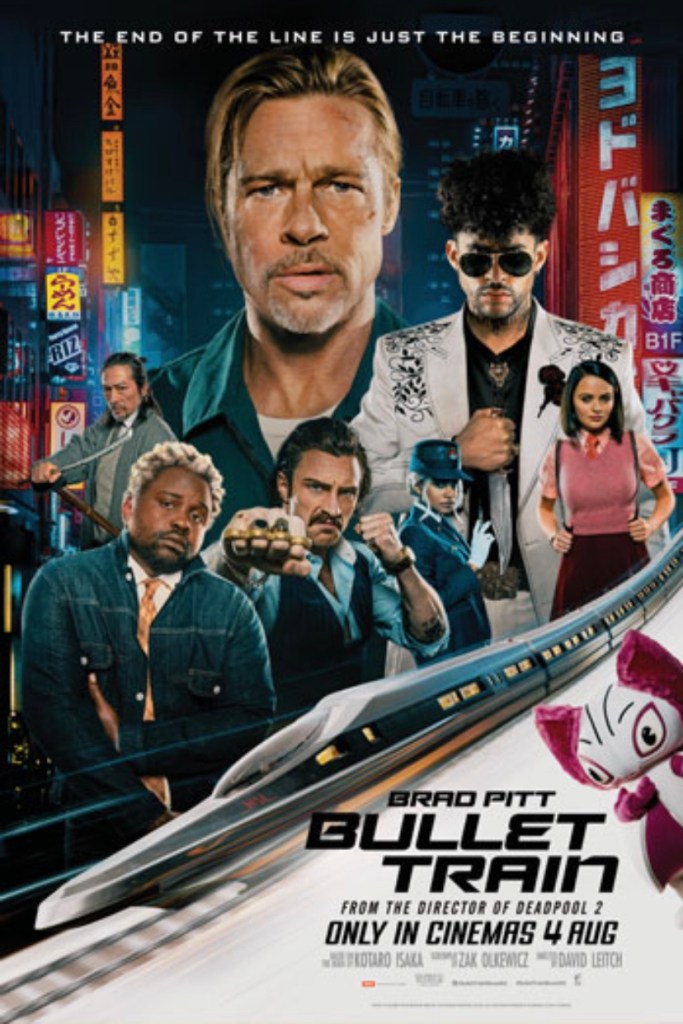
.
Five killers board a train from Tokyo.
Satoshi, teenage schoolboy and viciously cunning psychopath.
Kimura, a father determined to exact his revenge.
Nanoa, the unluckiest assassin in the world.
Tangerine and Lemon, a deadly duo.
Why are they all on the same train and who will reach the end of the line alive?
.
That is the blurb on the back of the original Bullet Train book.
The first big difference with the film is that the assassin is not called Nanoa. This might be an assumption on my part as he is only ever referred to as Ladybug, a code name he also has in the novel, but he’s played by Brad Pitt so I’m confidently going to suggest that’s not what the character’s parents chose for him. This and much of the other casting in the movie has lead to accusations of whitewashing as most of the people on the titular locomotive are British or American here, rather than Japanese as they are in the source material. I can see why this has come up but I’m not sure it is entirely fair in this case. The third Fast and Furious film was set in Japan too and a lot of the faces were from the US there as well. It is entirely feasible that these people would be in this situation and it is not the first foreign source material to get translated in this way. (Case in point, one of the trailers I saw before the movie was for Laal Singh Chaddha which I delightedly came to realise is an upcoming Indian version of Forrest Gump.) They could have transposed the whole thing across the Pacific but keeping the Japanese setting does honour and celebrate the culture and sensibilities of the novel and like Fast and Furious: Tokyo Drift it means that there are Asian actors in it too, including the excellent Hiroyuki Sanada. I get the issue with making these changes to an existing Japanese story but let’s be honest, the book isn’t exactly Shikibu’s The Tale of Genji is it.
The other thing here is that so much of the film depends and plays on the personality and celebrity of its well known cast, mostly in the cameos but also in its main players. It would be nice if you could get this from an international group of actors but that is not yet the world the global audience lives in so if director David Leitch wanted to do this, which he clearly did, then these decisions were necessary. There could well be a great film of this book with just Japanese performers but it wouldn’t be this film. All of the actors do wonderfully mannered turns; Pitt and Aaron Taylor Johnson in particular. It is hard to argue that they should not have been playing these parts in the film as it is presented.
There is a much better and fuller exploration of all of this here.
The next aspect they have changed is the psychopath teenage boy, as in the film he is a girl (also not Japanese.). The part is played by Joey King who is so much more convincing as a brutal killer here than she was in her last movie The Princess. Comparisons here are inevitable due to the proximity of the two film’s releases but also because her character name in this happens to be Prince.
Where her Prince wins over her Princess is in the coldness; who knew that this actor who has so often played sweet could be so nasty? The primness suits her too and this was something she was playing against in The Princess. As well as being a good part for King it is also a strong part for a young woman so while there may be some issue with the casting elsewhere, there is no problem with this being gender flipped.
Something else that does not align with the back of the book is that there are more than five killers on board this train. To be fair, this is also the case within its own pages. Bullet Train is full of people trying to off each other and as you might expect from the director/producer behind John Wick, Deadpool 2 and Hobbs & Shaw, it is frenetic, exciting and a lot of fun. Get on this train and you’ll find it is a bit of a roller coaster. Some of the people you expect not to be assassins are and some you expect to be are not and it’s a very enjoyable ride. The cast, which in any other case would actually be heralded as quite diverse, are all strong and the film is built around character as much as the action. Aside of those already mentioned I have to give a shout out to Brian Tyree Henry who, as Lemon to Taylor-Johnson’s Tangerine, has a random thing for Thomas the Tank Engine and a theory about how people can be judged against which of the engines in these stories they are most like, which somehow works. I actually have a similar idea connected to the animals in Winnie the Pooh.
I don’t really know what the book of Bullet Train is like then, I understand some of the prose is clunky in the translation but it is a compelling read. In terms of the film though, even with the alterations (problematic or not) the journey from page to screen is a successful one.
 The Not Left Handed Film Guide